Vinitharya: “Harrier of the Easterlings”
But Eldacar did not prove easy to thrust from his heritage. To the lineage of Gondor he added the fearless spirit of the Northmen.
—The Lord of the Rings, Appendix A, I “The Númenórean Kings”, (iv) “Gondor and the Heirs of Anárion”
Note: In this article I use the term “Old Rhovanion” to refer to the time of Vidugavia, self-styled King of Rhovanion. As far as I am aware, this term was coined by Jim Allan for his 1978 book, An Introduction to Elvish (“Old Rhovanion Names”, p. 189-190). I have taken the liberty of introducing another term, “Late Rhovanion”, to distinguish the time of Marhari and his successors from that of Vidugavia. However, in this article I mostly ignore that time period. My object here is to explain the three names of Old Rhovanion: Vidugavia, Vidumavi, and Vinitharya, and in particular the latter name, about which there has been some uncertainty. Here I present what I believe is a novel etymology that explains the form of the name as Tolkien wrote it.
The Language of Old Rhovanion
Unfinished Tales of Númenor and Middle-earth is, in a sense, the “Extended Edition” of the Appendices to The Lord of the Rings. Among the various items of note it contains for Rohan enthusiasts are a chapter titled “Cirion and Eorl and the Friendship of Gondor and Rohan”, on the background of the Rohirrim and the founding of Rohan. In a note in this chapter Christopher Tolkien makes the following observation:
It is an interesting fact, not referred to I believe in any of my father’s writings, that the names of the early kings and princes of the Northmen and the Éothéod are Gothic in form, not Old English (Anglo-Saxon) as in the case of Léod, Eorl, and the later Rohirrim.
He then goes on to discuss the names of various forebears of the Rohirrim, including Vidugavia, Vidumavi, Marhwini, and Marhari—the latter two making their first public appearance in Unfinished Tales (1980). Curiously, he neglects to mention Vinitharya. Vinitharya was Gondorian on his father’s side, and would ultimately become King Eldacar of Gondor, but his birth name was from the language of the Kingdom of Rhovanion, a forerunner of the Rohirrim. Forthwini, son of Marhwini, is also left out.
Christopher Tolkien was not only his father’s literary executor and the person most familiar with his varied writings, but he was also himself a philologist by training, versed in the ancient Germanic languages, and like his father an enthusiast of the Goths. Perhaps his most notable academic contribution not directly related to his father’s writings was a Modern English translation of Hervarar saga ok Heiðreks, titled The Saga of King Heidrek the Wise (available for download here). Although the language of the work as we have it is Old Norse, some of the subject matter clearly references the Goths. Fans of J.R.R. Tolkien will also note various elements from the saga, such as a cursed sword, a riddle contest, and a forest called “Mirkwood”, that have found expression in his writings.
Those who are unfamiliar with the historical Goths and their relation to Tolkien and his writings may wish to check out this 2021 talk by Elizabeth Solopova at the Bodleian Library in Oxford. It is 40 minutes long.
Gothic or not Gothic?
Christopher Tolkien’s note is not much more than an aside, calling the reader’s attention (with some enthusiasm, no doubt) to something that he thinks is interesting. Unfortunately, and with all the respect that is due to Christopher Tolkien, it is somewhat misleading. It can hardly be doubted that the name Vidugavia is Gothic in origin. However, its form has clearly been Latinized (or perhaps Quenyafied, rather). Its Gothic form should be Widugauja, if not 𐍅𐌹𐌳𐌿𐌲𐌰𐌿𐌾𐌰. This is being rather pedantic, though, and to the trained philologist the change in orthography is quite transparent.
More serious, however, is the attempt to explain the names Marhari and Marhwini as Gothic. Whatever language the element wini may be supposed to have been taken from, if it is assumed to be cognate with Old English wine (“friend”), then it is a decidedly non-Gothic form. From comparative philology we know that the expected Gothic reflex of Proto-Germanic *winiz (“friend”) is wins, and we also have the attested name Batwin (𐌱𐌰𐍄𐍅𐌹𐌽, “Good Friend”), a Gothic Christian martyr. Batwin is in the accusative case, but we have every reason to expect that it would have been *Batwins in the nominative case.
With the element hari, or harya (presumably cognate with Old English here, “army”), there is a little more leeway: hari in the vocative and accusative cases, and harja in the dative case, in Gothic. However, Tolkien was a native speaker of Modern English, a language with no case distinctions except in pronouns (I/me/my, he/him/his, she/her, etc.). More importantly, most of his intended audience was of a similar background, but did not have his philological knowledge. At any rate, there is really no reason why Tolkien should not have defaulted to the nominative case in his names. In Gothic the nominative form of this word is harjis. If Vinitharya’s name were Gothic in form, we would expect it to be something more like Vinitharyis, accounting for Quenyafication—if, indeed, the latter element is taken to be a reflex of Proto-Germanic *harjaz (“army”).
I am not alone in questioning Christopher Tolkien’s statement. Various Tolkien scholars and linguists, including Tom Shippey, David Salo, and Arden R. Smith have given their own scholarly opinions on the names of the Northmen of Rhovanion. Several of the names have been identifed variously as Proto-Germanic, Old High German, early Old English, or Old Mercian—a dialect of Old English.
Old and Late Rhovanion
At this point it is worth pointing out something about the people who bear these names: Vidugavia, Vidumavi, and Vinitharya represent three successive generations. Vidugavia is first mentioned in the year 1250 of the Third Age, and his grandson Vinitharya was born five years later, in T.A. 1255. Marhari and Marhwini, however, are first mentioned in T.A. 1856, which is six hundred years later. This puts them about halfway between Vinitharya and Léod, father of Eorl, who was born in T.A. 2459. It is reasonable, then, to suppose that the language of Marhari and Marhwini may be different from that of Vidugavia—that is to say, that the language J.R.R. Tolkien used to create their names may be something other than Gothic, despite what Christopher Tolkien said. For this reason, I will only discuss three names in this article, which I will presume to be Gothic: Vidugavia, Vidumavi, and Vinitharya.
The Germanic Languages
Before continuing, however, it is worth illustrating the relationships between the various ancient Germanic languages. The figure below is a tree diagram representing those relationships. It is not the only arrangement that has been proposed, but it is the arrangement that I believe best represents the conventional view of Germanicists. Names in bold type are attested ancient Germanic languages. Names in bold italic type (that is, Gothic) are attested languages with no living descendants. Other names are unattested languages (or at least language groups) that are believed to have once existed. (Although Proto-Northwest Germanic and Proto-Norse are attested to some extent in runic inscriptions.)
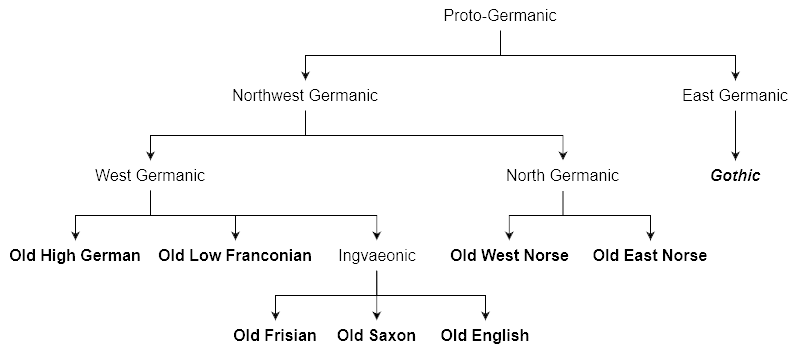
Old East Norse includes Old Danish and Old Swedish. Old West Norse includes Old Norwegian and Old Icelandic. Old High German is the ancestor of Standard German. Old Low Franconian is also known as Old Dutch. Old Saxon is also known as Old Low German, and is the ancestor of the modern Low German, Saxon, or Plattdeutsch dialects of German. Old Frisian is the ancestor of the modern West Frisian, North Frisian, and Saterland (East) Frisian languages. Old English is, of course, the ancestor of Modern English, as well as Scots, which some consider a separate language. The height of the nodes in this particular diagram is not necessarily related to age: Old English is the earliest well-attested ancient Germanic language, after Gothic; whereas Old Frisian is the latest.
A few notes on orthography are given at the end of this article, for those who are unfamiliar with the conventions regarding the use of letters such as j, þ, ą, or ġ.
Words or forms of words that are unattested in ancient writing are marked with an asterisk, like this: *wins. In some cases a double asterisk is used for forms that are particularly uncertain or dubious, for example: **þarja.
Gothic Names of Old Rhovanion
Vidugavia
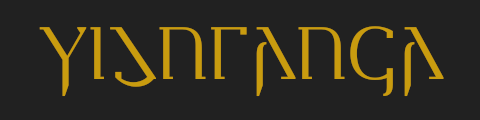
The name Vidugavia is undoubtedly intended to be a Quenyafication of Widugauja (𐍅𐌹𐌳𐌿𐌲𐌰𐌿𐌾𐌰). This name is apparently composed of the Gothic elements widus (“wood”) and gauja (“dweller”, “inhabitant”). The reconstructed Proto-Germanic forms of these elements are *widuz and *gawjô.
widus
The word *widus is not actually attested in Gothic. However, widu is attested in Old English and Old Saxon, and witu in Old High German as a word for “wood”, or “forest”. Also, Old Norse has viðr. In Old English the word was subject to a sound change after which it was more commonly written as wudu.
gawi
In discussing the second element of this name, it is important to distinguish two related words: gawi and gauja. The former word is from Proto-Germanic *gawją and meant “district” or “region”. It was itself probably a combination of *ga (“with, near, by, along”) and *awjō (“land by a waterway”). From the latter element came Old English īeġ and Old Norse ey, meaning “island”. Indeed, the Modern English word “island” derives from Old English īeġland. The ahistorical s is due to the influence of the Latin word insula, from which our word isle is derived. The words “isle” and “island” are actually unrelated.
Proto-Germanic *gawją is also the ancestor of the German place name element -gau, as in Breisgau and Oberammergau, and the Dutch go as in Westergo and Oostergo (West Frisian Westergoa and Eastergoa). In England this word was largely discarded in favor of sċīr (“shire”), but it survives in a few place names, most notably Surrey (Old English Sūþriġē, “southern district”).
gauja
The Gothic word gauja is a compound of gawi and -ja, a masculine agentive suffix. Thus a gauja was a man who lived in a particular gawi. If the word existed in Proto-Germanic, it likely would have had the form *gawjô (adding the suffix *-jô to the word *gawją)—assuming I’ve interpreted Sievers’ Law correctly—or perhaps *gawijô. The “yeo” in the English word “yeoman” may be a cognate of this word, from Old English *ġēamann, from Proto-West Germanic *gauwjō + *mann. Alternatively, maybe it is a cognate of the previous word, from Proto-West Germanic *gawi + *mann.
Attestations of the elements
Both words are attested in Gothic, but neither is in the nominative singular form. The Gothic Bible contains the word gauja (𐌲𐌰𐌿𐌾𐌰) in Matthew 8:28, but it is in fact the dative singular form of gawi, meaning “region” or “country”. The word gaujans (𐌲𐌰𐌿𐌾𐌰𐌽𐍃) is attested in Luke 8:37, where it is the nominative plural form of gauja, meaning “inhabitants”.
Attestation of the name
The name Widugauja is not attested in Gothic writings. However, the Gothic historian Jordanes, writing in Latin, recorded Vidigoia as the name of a hero of the Goths. Vidigoia led his people into battle against the Sarmatians, a powerful nation of the Eastern European steppes. Although he lost his life in the battle, the Goths were victorious. His name appears to have entered into Germanic folklore as the son of Weland the Smith. It appears in various forms, such as Witigouwe, Witicho, Witege, and Wittich, in medieval German sources; as Viðga in Old Norse; and as Wudġa and Widia in Old English.
Vidumavi
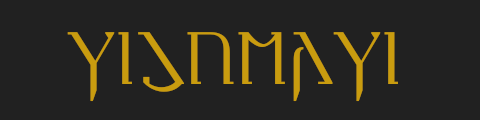
The name Vidumavi would be Widumawi (𐍅𐌹𐌳𐌿𐌼𐌰𐍅𐌹) before Quenyafication. This name contains the the Gothic elements widus (“wood”) and mawi (“girl”). The reconstructed Proto-Germanic forms of these elements are *widuz and *mawī (from earlier *magwī).
mawi
The first element has already been treated at length above. The second element is the feminine counterpart of Gothic magus (“boy”), from Proto-Germanic *maguz. Both words are also related to Proto-Germanic *magaþs (“maiden”). From a diminutive form of this word, *magaþīn (if it existed in Proto-Germanic; otherwise Proto-West Germanic *magadīn), is derived the English word “maiden”.
There is no attested reflex of Proto-Germanic *mawī in Old English. However, this word also had a diminutive, reconstructed as *mawilǭ (“little girl”). This word is also attested in Gothic as mawilō, and in Old English as mēowle. (Which possibly influenced the name of a character in The Book of Lost Tales, although the influence would have been more from the word’s orthography than its pronunciation.)
Attestations of the element
Both mawi and mawilō are attested in the Gothic Bible, particularly in the story of the daughter of Jairus. In most instances she is referred to as mawi (𐌼𐌰𐍅𐌹), but in Mark 5:41, when Jesus addresses her directly in Aramaic as talitha (“little girl”), the word is translated into Gothic as mawilō (𐌼𐌰𐍅𐌹𐌻𐍉).
Attestation of the name
The name Widumawi is not attested in Gothic. In fact, neither mawi nor mawilō are attested as elements of Gothic names. However, it must be said, of course, that the number of attested Gothic feminine names is quite small.
Vinitharya
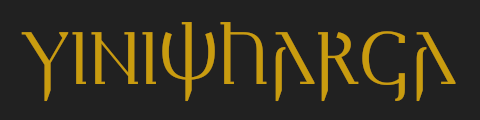
The name Vinitharya is usually understood as deriving from the Proto-Germanic roots *Winidaz or *Winiþaz (“Wend”) plus *harjaz (“army”). This would yield either Winidharjis (𐍅𐌹𐌽𐌹𐌳𐌷𐌰𐍂𐌾𐌹𐍃) or Winiþharjis (𐍅𐌹𐌽𐌹𐌸𐌷𐌰𐍂𐌾𐌹𐍃) in Gothic. In the former case, the d may be assumed to have become devoiced to t due to the influence of the following voiceless h. However, I believe Tolkien intended his audience to understand the sequence th in the name to be pronounced as in most English words.
An alternative interpretation is difficult to infer. For example, perhaps the first part of the name could be interpreted as deriving from Proto-Germanic *winiz (“friend”), Gothic *wins (possibly *wini- as a prefix). However, it is not clear what **þarja could mean. For this reason I will assume that the conventional interpretation is correct, for now.
Winid or Winiþ
The first element is the name of a people, known to the Romans as the Veneti, Venedi, Venethi, or Venedæ. There are several ancient people known by the name “Veneti”: the Gallic Veneti, who lived in what is now Brittany in France; the Adriatic Veneti, who gave their name to the city of Venice in northeastern Italy; and the Baltic Veneti, or Vistula Veneti. This latter group is apparently the source of the name in question. They lived in the vicinity of present-day Belarus and Lithuania.
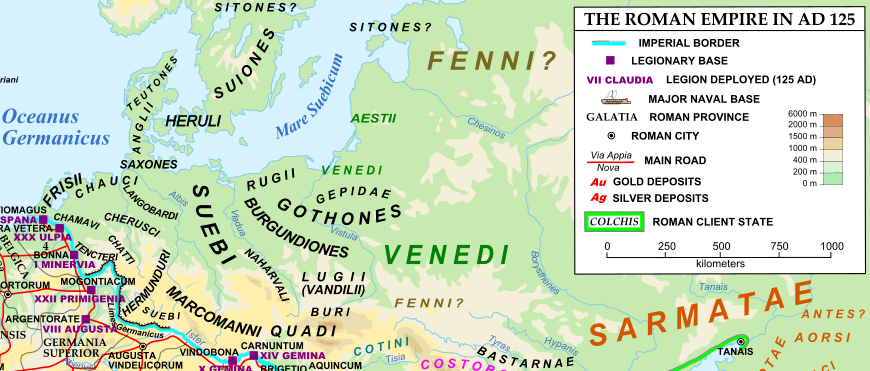
The exact identity of this group has been subject to debate. Pliny the Elder called them Sarmatæ Venedi, implying a relationship with the Sarmatians. Tacitus mentioned them along with the Fenni (Finns) and the Peucini as a group of people he was unsure how to classify. However, he mentioned that the Peucini (also called Bastarnæ) were like the Germans in language, implying that the Veneti were not. Possibly they were the ancestors of the Prussians, a people who spoke a Baltic language. On the other hand, Jordanes says the Veneti were the ancestors of the Antes and Sclaveni—that is to say, of the East Slavs and the South Slavs.1
Whatever the case may be, it is known that certain West Slavic peoples occupied territory in northeastern Germany after it had been depopulated due to various southward and westward migrations of Germanic peoples. These newcomers, who became the eastern neighbors of the Saxons, came to be called “Wends” (in various forms). Over time, many of them became assimilated into the population of Germany, but a small group known as the Sorbs still speaks a Slavic language.
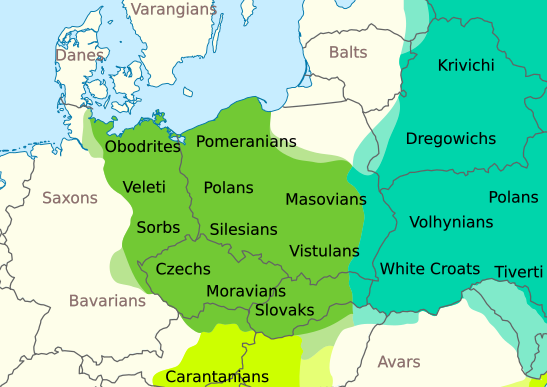
Whether the Wends had any relation to the Roman-era Veneti is not known for certain. Possibly the Germans just gave them the same name they had always given their non-German eastern neighbors. On the other hand, perhaps there was a known continuity between the Veneti and the Wends. Certainly, if Jordanes was correct that the East and South Slavs were descended from the Veneti, it would make sense if the West Slavs also shared in that descent.
The Old Saxon name for these people was Winoth, from which comes Modern German Wende and Modern English Wend. The Old High German term was winid, from which comes Modern German Winde (now usually Windischer)—although this term is used to refer to the Slovenes, a South Slavic people. The Old Norse word for the Wends was Vindir or Vindr. In Old English they were called Winedas.
Note that the Old Saxon and Old High German names appear to be reflexes of a Proto-Germanic *Winiþaz (OHG d > t, and þ > d ), but the Old English and possibly the Old Norse names seem to be reflexes of a Proto-Germanic *Winidaz. Perhaps both forms existed in Proto-Germanic, or perhaps the pronunciation varied depending on the case of the noun, reflecting an earlier difference in stress. On the other hand, considering the Anglo-Saxons no longer lived near the Wends and had little reason to speak of them, perhaps they borrowed the form winid into Old English from a Continental (Old High German) source.
In the context of The Lord of the Rings, the term Winiþ should be understood as referring not to any real-world ethnicity, but to the people who are generally known as the “Easterlings” in the narrative, or possibly a subgroup thereof.
harjis
The Proto-Germanic word *harjaz (“army”) is one of the most common elements in early Germanic names. The elements *wulfaz (“wolf”) and *gastiz (“guest”) are also quite common, but both are more common as the second element of a name. The element *harja(z) occurs frequently as either the first or second element of dithematic Germanic names.
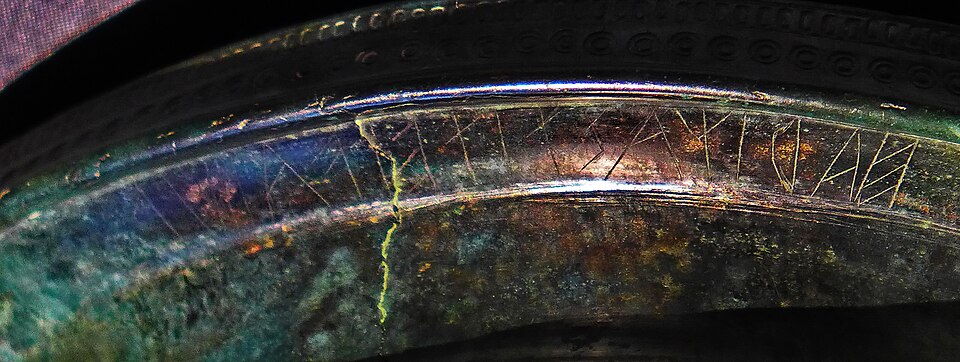
The word is possibly attested as early as the 2nd century BC, in an inscription on the Negau B helmet. The inscription is in a North Etruscan (or North Italic) alphabet, and is transcribed as hariχastiteiva. This is usually parsed as Harigasti teiwa based on the assumption that the language is Germanic. Possible interpretations are “Harigasti the priest” or “divine Harigasti”. Harigasti is presumed to be Proto-Germanic *Harj(a)gasti(z), though why the final a of *harja- and the final z of *gastiz are elided is a matter of debate.
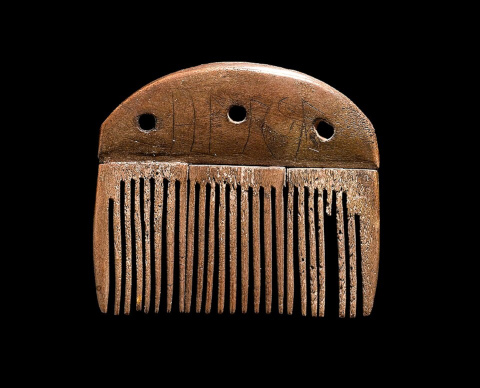
One of the oldest unambiguously runic artifacts is the Vimose comb (ca. AD 160), whose inscription reads harja (ᚺᚨᚱᛃᚨ). This is often interpreted as a personal name or name element *harjaz, or as a word meaning “commander” (of an army). An alternative interpretation is that it means something like “for hair”.
The *harjaz element is also attested in the 5th-century Rö runestone in Sweden, which contains the word Swabaharjaz or Swabaharjaʀ (ᛊᚹᚨᛒᚨᚺᚨᚱᛃᚨᛉ). The form is either Proto-Northwest Germanic or Proto-Norse. This word is interpreted as either “Suebian warrior” or as a personal name. The Suebi (also Suevi or Suavi) were a confederation of Germanic tribes, most of whom lived around the Elbe River. As a name, Swabaharjaz is attested in Old Norse as Sváfarr, in Old English as Swǣfhere, and in Old High German as Suābheri.
harja (non-Gothic)
As noted above, the expected Gothic reflex of Proto-Germanic *harjaz would be Gothic harjis. For this reason, some scholars have been reluctant to intrepret Vinitharya as a Gothic name. The form *harja is valid, but only as the dative case of harjis, and why Tolkien should use the dative case for this particular name is unclear.
Perhaps the name is not Gothic at all, but something like Proto-Germanic. However, if “Proto-Germanic” is to be understood as the common ancestor of all the known Germanic languages, then we would expect a final -z, given the s in Gothic harjis and the second r in Old Norse herr (-arr in personal names). At least, that is if we take the name to be in the nominative case.
A better fit, in my opinion, would be an intermediate stage between Proto-Northwest Germanic and Proto-West Germanic. The reconstructed Proto-Northwest Germanic form is *harjaz, the same as Proto-Germanic. For Proto-West Germanic the form *hari is reconstructed. At some point between the two, the final z was lost, and then the final a, the j becoming vocalized to i. I am also of the opinion that the z became rhotacized (though not pronounced identically to the reflex of Indo-European r) at some early point in this transition. The total sequence of sound changes would then be: *harjaz > *harjaʀ > *harja > *harj > *hari. The middle stage would then correspond to the second element of Vinitharya.
There is a potential problem with this hypothesis, other than its obscurity: why is the final a lost from *Winida / *Winiþa before it is lost from *harja? If anything, I would expect it to be the other way around. A medial vowel may become fossilized, as we see in Anglo-Saxon names such as Cynewulf.
harjan and harja
There is yet another problem: we have already established, I think, that Widumawi and particularly Widugauja are Gothic in form. Why would people bearing these names choose to name their descendant in a different language—and one that does not descend directly from Gothic?
In fact, we have already seen what I believe is the solution to this problem. Recall that the Gothic word *gauja is *gawi plus the agentive suffix -ja. What if the -ja in *harja is an agentive suffix as well? Although it is not attested in Gothic, there is a verb attested in various other Germanic languages whose Proto-Germanic form would have been *harjōną. Its Modern English reflex is the verb harry.2 Its Gothic reflex would be *harjan (𐌷𐌰𐍂𐌾𐌰𐌽).
Deriving a masculine agentive noun from the verb *harjōną using the suffix *-jô would give us Proto-Germanic *harjô. The Gothic reflex would then be *harja (𐌷𐌰𐍂𐌾𐌰). This matches exactly with the (h)arya of Vinitharya. The Gothic form of the name would then be either Winidharja (𐍅𐌹𐌽𐌹𐌳𐌷𐌰𐍂𐌾𐌰) or Winiþharja (𐍅𐌹𐌽𐌹𐌸𐌷𐌰𐍂𐌾𐌰). Its Old English cognate would not be Winedhere then, but rather something like Winedherġa.3
Objections
There are probably various reasonable objections to this hypothesis. I will just note a couple: 1) reflexes of Proto-Germanic *harjaz are abundant in personal names, whereas reflexes of Proto-Germanic *harjô are, as far as I am aware, unattested; 2) at any rate, neither the verb *harjan nor the noun *harja are attested in Gothic. My brief response is that Tolkien was perfectly capable of inventing these forms himself. It’s the sort of thing he did.
“Harrier of the Easterlings”
There is what I believe is a strong argument in favor of this hypothesis. In The Peoples of Middle-earth (History of Middle-earth, vol. XII), Christopher Tolkien writes the following regarding the text of Appendix A:
In the long version there is a footnote to the name Vinitharya: ‘This, it is said, bore much the same meaning as Rómendakil.’
—Peoples of Middle-earth, Part I: The Prologue and Appendices to The Lord of the Rings, IX. “The Making of Appendix A”, (i) The Realms in Exile
Rómendacil (as it appears in The Lord of the Rings as published) was the name assumed by Minalcar, Regent (later King) of Gondor, after defeating a large Easterling army in the year 1248 of the Third Age. The name is Quenya, from rómen (“east”) and (n)dacil (“victor”). Minalcar was not the first King of Gondor to assume this name: in T.A. 500 Tarostar called himself Rómendacil after fighting off an Easterling invasion of Gondor. Rómendacil II, however was the grandfather of Vinitharya. It is likely then, that Vinitharya was a deliberate calque of the name Rómendacil, after Rómendacil II.
At the time, Rómendacil was seeking an alliance with the Northmen against the Easterlings. He sent his son Valacar to the Kingdom of Rhovanion for that purpose. It seems less likely that Valacar would have given his son a name meaning “Easterling Army” (Winiþharjis) than a name meaning “Harrier of the Easterlings” (Winiþharja).4
This, then is my proposed solution: after accounting for the Quenyafication of its orthography, the name Vinitharya is purely Gothic in form; however, it does not mean “army of the Easterlings”, but rather “one who harries the Easterlings”.
Attestations of the element
Of the elements discussed above for the name Vinitharya, only harjis (“army, host”) is attested in Gothic. In Luke 2:13 it is used to refer to the heavenly host of angels praising God at the birth of Christ. In Luke 8:30 it is what the man possessed by many devils calls himself (translated as “Legion” in the King James Version of the Bible).
Attestation of the name
Although the element *Winid or *Winiþ is not attested in Gothic writing, it likely forms the first element of the name of Vinitharius, a Gothic king mentioned by Jordanes. Vinitharius is said to have become king of the Greuthungi (identified by Jordanes with the Ostrogoths) after the death of Ermanaric. According to Jordanes, Vinitharius fought and defeated the Antes, who are usually regarded as a proto-Slavic people.
In this case, the form of the name does appear to derive from Gothic *Winiþharjis. Perhaps an ahistoric s was appended to *Winiþharja, which would make more sense if his name were to be understood as an assumed name, like Rómendacil in Appendix A of The Lord of the Rings. If “Vinitharius” was his birth name, however, it is quite possible that it reflects an earlier time in which an army of “Easterlings” was not necessarily viewed as an enemy by the Goths.
Conclusion
Given the above, my conclusion is that the names of Vidugavia, Vidumavi, and Vinitharya (representing three successive generations) are all Gothic in form, not Proto-Germanic, early Old English, or some other attested or reconstructed ancient Germanic language. However, the name Vinitharya does not contain the word meaning “army”, attested as harjis in Gothic, which is a common element in Germanic names. Rather, the second element in the name Vinitharya is a Gothic agentive noun *harja, meaning “one who harries”, or “one who attacks with an army”. This accords with Tolkien’s statement that the name “bore much the same meaning as Rómendakil”, a Quenya name meaning “East victor”—that is, “victor over the East”. Incidentally, this is not a prophetic name, as the principal conflict of Vinitharya’s life was a Gondorian civil war that was fought largely between the North and the South, and in which he himself was, relatively speaking, an “Easterling” as well as a Northman.
Notes
-
- It should be noted that Balto-Slavic is a well-accepted subgroup of Indo-European, so at some point far enough in the past, the distinction between the Baltic and Slavic languages did not exist. However, the split likely happened some centuries before the first mention of the Vistula Veneti, so their language must have been either Baltic or Slavic, if not something else. ↩
- This verb means something like “to attack” or “to harass”. The Modern English noun “harrier” is derived from it. As well as referring to a person who harries, it is also the name for several species of birds of prey (and a British combat aircraft), as well as an alternative name for harehounds. ↩
- The canonical Old English form of this word would probably be herġia. The verb meaning “to harry” is variously attested as hergian, hergean, hergan, herigan, herian, and heregian. This verb (from Proto-Germanic *harjōną) is not to be confused with another verb (from Proto-Germanic *hazjaną), meaning “to praise”. The latter verb was variously written as herian, herigan, hergan, hergean, herigean, and hærian in Old English. To distinguish them, Anglo-Saxonists prefer to use herġian for the verb meaning “to harry” and herian for the verb meaning “to praise”.↩
- When Valacar was recalled to Gondor, he gave his son Vinitharya the Quenya name Eldacar (literally “Elfhelm”). And his wife Vidumavi was called Galadwen, which could be interpreted as “Radiant Maiden” or “Maiden of Light” in Sindarin. However, probably Galadhwen was intended. Tolkien was known to vacillate between galad and galadh for “tree”, as he also vacillated between using c or k in Rómendacil, for example. If Galadhwen (“Tree Maiden”) was intended, then it would be a calque of her birth name, Vidumavi (“Forest Maiden”). ↩
Notes on Orthography
A few notes on Germanic orthography may be of use to those who are unfamiliar with the conventions.
The earliest Germanic languages, including the oldest recorded forms of Old High German, had the sound represented by th in the English word “thorn”. In Old English and Old Norse writing this sound could be represented using the letter þ, which is called “thorn”, and was originally borrowed from the letter ᚦ of the runic alphabet. Germanicists conventionally use this letter for the “th” sound in reconstructed languages, such as Proto-Germanic, as well as to transcribe the corresponding rune, or the Gothic letter 𐌸.
The letter ð is likewise used for the “th” sound in the English word “that” in Old Icelandic, in some representations of Old Saxon, and sometimes in reconstructed Germanic languages. (It was also used in Old English, but there it and þ were both used interchangeably.)
The ancient Germanic languages had long vowel sounds. It is believed that these differed from short vowels primarily in the length of time they were held for. When ancient Germanic languages were written down, vowel length was rarely indicated. Modern scholars prefer to explicitly indicate the vowel length, but a number of different conventions have been used in the past. The modern consensus is to favor the use of the macron for most languages. For example, Old English þūsend (“thousand”), where the long u is indicated with a macron. The exception is Old Norse (or specifically, Old Icelandic), where the acute accent is favored instead. For example, Old Icelandic þúsund (also “thousand”). In The Lord of the Rings Tolkien differed from modern scholarly practice in using the acute accent for Old English.
In addition to normal (bimoric) long vowels, Proto-Germanic is believed to have had “overlong” (trimoric) vowels. There are several ways of indicating this, but for convenience most people use a circumflex. For example, Proto-Germanic *gawjô (“inhabitant”), where the last vowel is overlong.
Proto-Germanic is also believed to have had nasalized vowels. These are indicated with an ogonek, as in *gawją (“district”) and *mawilǭ (“little girl”), where the last vowel in both words is nasalized. (These are presumably from earlier *gawjam and *mawilōn.) This should not be confused with the letters ę and ǫ of Old Icelandic, where the hook indicates the vowel is low or lax, not nasalized.
Germanicists usually use the letter j to indicate the sound of y in English “year”. In Old English the same sound was usually written using g, or the combinations ge or gi. Modern scholars use a dot over the g to indicate this pronunciation, as in Old English ġē (“district”). Similarly, a dot is placed over a c to indicate a palatalized pronunciation: ċēosan (“to choose”), sċīr (“shire”).
Finally, a small capital r is used to indicate the sound of Proto-Germanic *z after it had become rhotacized, but before it merged with Proto-Germanic *r: ʀ. The exact sound this represents is a matter of debate, but it was probably something like the ř of the Czech surname Dvořák, or the rr in some Latin American dialects of Spanish. The ʀ has traditionally been used to represent the ᛉ rune in Proto-Norse runic inscriptions. It is also sometimes used in reconstructed languages such as Proto-West Germanic. ↩
Illustrations
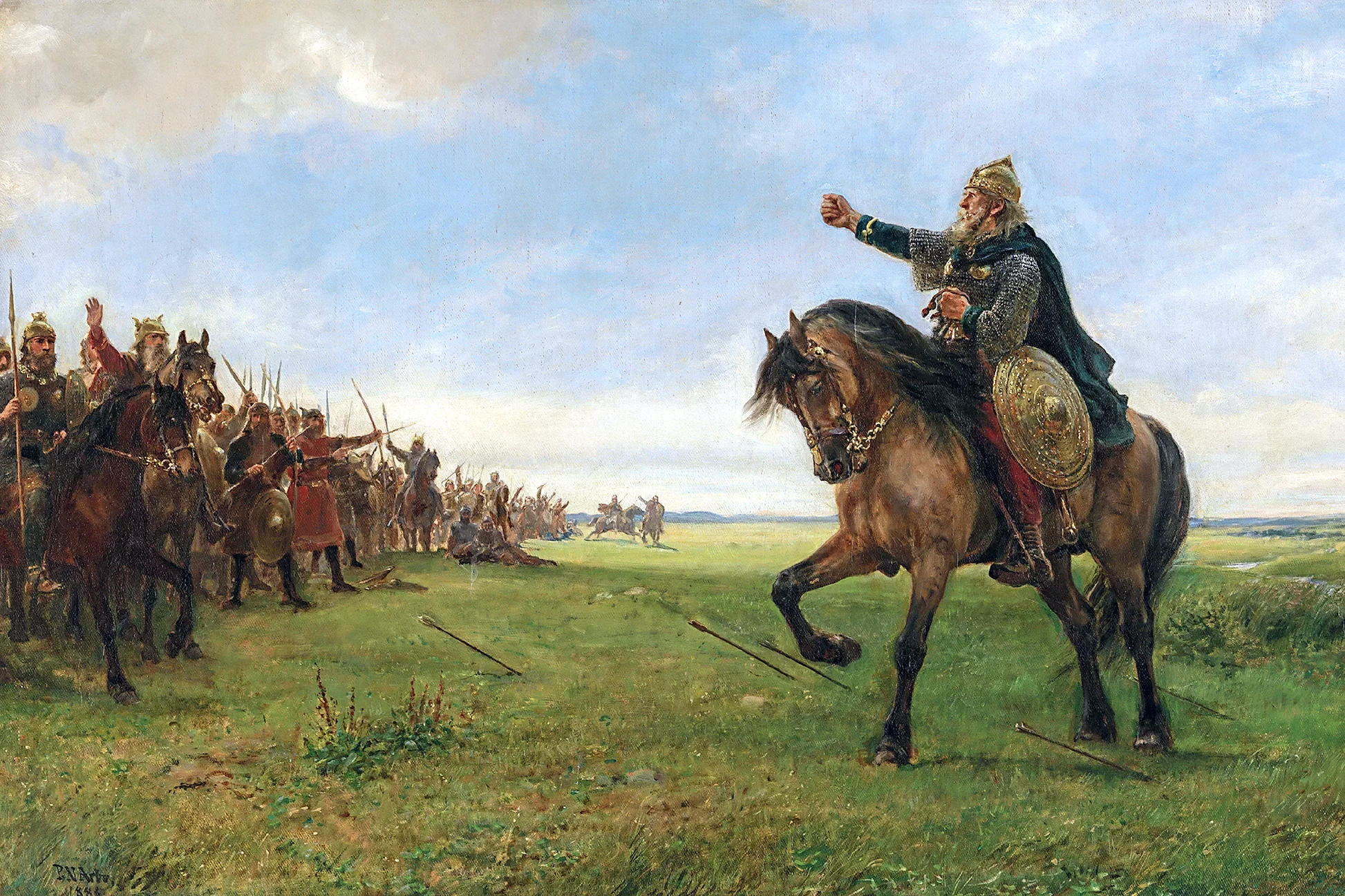
Featured Image: “Gizur Challenges the Huns” (1886), a painting by Norwegian artist Peter Nicolai Arbo. It illustrates an incident from “The Battle of the Goths and Huns”, in the Saga of King Heidrek the Wise. (public domain)
“The Roman Empire in 125”, by Wikipedia user Andrein. (public domain – cropped for detail)
“Slavic tribes in 7.-9. century Europe”, by Wikipedia user Revilo1803. Derived from “Slavic tribes in the 7th to 9th century.jpg” by Wikipedia user Jirka.h23. (Creative Commons Attribution-Share Alike 4.0 International license – cropped for detail)
“Helmet of Negau B (HARIGASTI-Inschrif); Kunsthistorisches Museum, Vienna”, by Wikipedia user Peter1936F. (Creative Commons Attribution-Share Alike 4.0 International license)
“Comb with runes HARJA. From Vimose, Næsbyhoved-Broby parish”, by Nationalmuseet, Roberto Fortuna, and Kira Ursem. (Creative Commons Attribution-Share Alike 2.5 Generic license – rescaled)





No Comments