The Language of Late Rhovanion
I go to my fathers. And even in their mighty company I shall not now be ashamed.
—Théoden Ednew (The Lord of the Rings, Book V, “The Battle of the Pelennor Fields” )
Late Rhovanion and the Éothéod
Previously, I discussed three names of Old Rhovanion: Vidugavia, Vidumavi, and Vinitharya—or Widugauja, Widumawi, and Winiþharja. I concluded that all three were Gothic in form, including Vinitharya. I set aside the other names Christopher Tolkien indicated were “Gothic in form”, only noting that they appeared six hundred years after Vinitharya’s birth. Here I will examine those names.
There are a number of names that occur between Vidugavia and Eorl, the founder of Rohan. Presumably they were descended from an unnamed son of Vidugavia’s, a brother to Vidumavi. Following Vidugavia (fl. T.A. 1250), the next named ruler of the Northmen of Rhovanion is Marhari (d. T.A. 1856). Marhari and his son Marhwini fought the invading Wainriders, an Easterling people, but were ultimately defeated, bringing to an end the Kingdom of Rhovanion.
Marhari died in battle, and Marhwini led the survivors to the Vales of Anduin. There they became known as the Éothéod—the “Horse Folk”. Marwhini was succeeded by his son Forthwini. Some time after Forthwini (fl. T.A. 1944), Frumgar (fl. T.A. 1977) became leader of the Éothéod. Although his exact relation to Forthwini is uncertain, it seems likely he was his grandson. Frumgar was succeeded by his son Fram (fl. ca. T.A. 2000), who slew the dragon Scatha.
Fram was succeeded as Lord of the Éothéod, after many centuries, by his descendant Léod (T.A. 2459-2501). Léod was succeeded by his son, Eorl the Young (T.A. 2485-2545), who led the Éothéod to the aid of Gondor, and was granted the land of Calenardhon (renamed Rohan) as a reward.
The Language of the Éothéod
Christopher Tolkien stated that the names of Léod and Eorl are Old English in form, and on this point I agree. The question is what language the other names are in, that is: Marhari, Marhwini, Forthwini, Frumgar, and Fram. Are they Old English too? Or are they Gothic? Are they some other language? Or are they a mix of languages? The interval between Marhari and Fram is only about 150 years, so it seems possible that they could all be the same language.
The names of Vidugavia (Widugauja), his daughter, and his grandson are all Gothic, I believe it is fair to say. However, Old English is not a direct descendant of Gothic. To use a family tree analogy, Gothic is more like an aunt of Old English. And ultimately it became extinct, so it doesn’t seem like a very fruitful source to look to for the language of the Éothéod.
Instead, since the ultimate result was Old English (the language used in The Lord of the Rings to represent that of Rohan), it makes sense to look at the evolution of English to see if we can determine the language(s) of Late Rhovanion and the Éothéod.
The Evolution of English
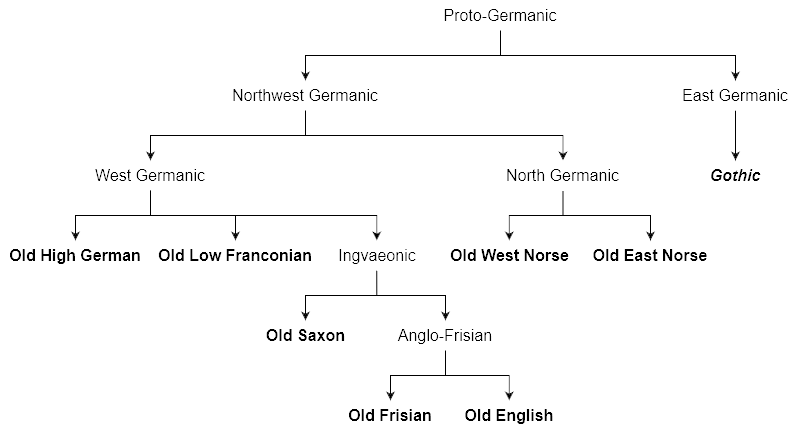
In my previous article on the Gothic names of Old Rhovanion I presented a tree diagram representing the development of the ancient Germanic languages. Below is a slightly different tree diagram. The difference is that I have added “Anglo-Frisian” as a node between Ingvaeonic and Old English (as well as Old Frisian), for the purposes of this article.
A discussion of the Anglo-Frisian question is beyond the scope of this article. Let it suffice to say that for some time most Germanicists have doubted the existence of a period of “Anglo-Frisian” unity. I am not necessarily questioning that here. However, for my purposes it at least makes sense to consider an “Anglo-Frisian” stage in the development of Old English—whether those developments were shared with Frisian, or were independent innovations.

English developed from Proto-Germanic by a long series of sound changes (and other changes as well). These changes occurred over a period of several centuries. It is helpful, for various reasons, to group these changes into certain discrete stages. Keep in mind, however, that these stages are somewhat artificial—although they may be based on real criteria. Old English did not suddenly appear when Germanic-speaking mercenaries set foot on Britain after the Roman armies had left, nor did it suddenly become Middle English when the Normans won the Battle of Hastings. With that said, here are the stages I will consider:
- Proto-Germanic. The common ancestor of all the Germanic languages.
- Proto-Northwest Germanic. The common ancestor of the Scandinavian and West Germanic languages.
- Proto-West Germanic. The common ancestor of English and the Continental Germanic languages. (This does not include Danish.)
- Ingvaeonic. (North Sea Germanic) The common ancestor of the English, Saxon (Low German), and Frisian languages.
- Anglo-Frisian. The common ancestor of the English and Frisian languages. (Disputed)
- Primitive Old English. A mostly unattested intermediate stage in the development of Old English.
- Old English. (Early West Saxon) Old English as recorded from the time of Alfred the Great.
I did not invent any of these terms myself, although there is some flexibility.
Proto-Northwest Germanic is sometimes called Common Germanic (a term also applied to Proto-Germanic) or Late Common Germanic. Where it is attested, it is often called Runic or (arguably) Proto-Norse (by some scholars). This is not to say that all “Proto-Norse” runic inscriptions are really Proto-Northwest Germanic, but some of the earliest inscriptions surely are.
The term “North Sea Germanic” is normally used as a synonym for “Ingvaeonic”, although some scholars seem to use it as a synonym for “Anglo-Frisian”. I have chosen to use the term “Ingvaeonic” as it is briefer, fairly well established, and perhaps less ambiguous. The linguist Don Ringe uses the term “northern West Germanic”, but I think it is easy to confuse with “Northwest Germanic”.
There seems to be a scholarly consensus that literary Old English was preceded by “POE”, but what POE should stand for depends on the scholar: Proto-Old English, Prehistoric Old English, Pre-Old English, and Primitive Old English are all contenders. I have opted for the latter term. “Early Old English” has also been used, although it is more properly used to refer to the attested Old English of ca. AD 700.
The term “Old English” usually refers to two closely-related variants which are conventionally called “Early West Saxon” and “Late West Saxon”. The former appears in the writings commissioned by Alfred the Great ca. AD 890. The latter was a standard written language promulgated by Bishop Æthelwold ca. AD 960 and typified by the writings of Ælfric. Despite the terms used, scholars of Old English typically view “Early West Saxon” and “Late West Saxon” as two closely-related dialectal variants, rather than seeing Late West Saxon as being a direct descendant of Early West Saxon.
Other notable dialectal variants of Old English include Kentish, Northumbrian, and Mercian. Old English poetry is mostly recorded in Late West Saxon; nevertheless, it includes many word forms apparently borrowed from Mercian. Old English prose is usually more purely West Saxon.
An Example
As an example of the kinds of changes that occurred over time, consider the Old English name Ēarendel. Several etymologies have been proposed for it, but the one I think most likely is “dawn” (Proto-Germanic *auziz, or perhaps *auzi) + “wanderer” (Proto-Germanic *wandilaz), here meaning “planet”.1 The latter word (usually in the plural) is also the name of a well-known Germanic tribe, the Vandals. The table below shows the development of the individual elements over time:
| Proto-Germanic | Proto-Northwest Germanic | Proto-West Germanic | Ingvaeonic | Anglo-Frisian | Primitive Old English | Old English |
|---|---|---|---|---|---|---|
| *auziz | *auʀiʀ | *auʀi | *auri | *ǣuri | *ǣor | *ēar |
| *wandilaz | *wandilaʀ | *wandil | *wandil | *wandil | *wendil | *wendel |
Putting the elements together gives the following:
| Proto-Germanic | Proto-Northwest Germanic | Proto-West Germanic | Ingvaeonic | Anglo-Frisian | Primitive Old English | Old English |
|---|---|---|---|---|---|---|
| *Auziwandilaz | *Auʀiwandilaʀ | *Auʀiwandil | *Auriwandil | *Ǣuriwandil | *Ǣorwendil | *Ēarwendel |
The Fossilization of Names
However, this assumes that the name was coined anew in each stage, or at least that it was analyzed in terms of its individual elements in each stage. In truth, names tend to become fossilized and develop differently from the elements they are composed of.
For example, the second element in the Old English name Е̄arendel is properly wendel.2 The word occurs separately in the Old English name for the Mediterranean, the Wendelsǣ.3 However, the name Е̄arendel became subject to a sound change in which w was lost following a medial consonant. Compare Old English singan (“to sing”) with Old Norse syngva, Gothic siggwan (𐍃𐌹𐌲𐌲𐍅𐌰𐌽, pronounced singwan).
In other cases the fossilization of names insulated them from some sound changes. For example, the Old English name Hildeþryþ is composed of the words hild (“battle”) and þrȳþ (“strength”). In Proto-Germanic the elements would have been *hildiz and *þrūþiz, giving the name *Hildiþrūþiz. The Proto-West Germanic form would have been *Hildiþrūþi.
In Primitive Old English there was a sound change that deleted short vowels at the end of a word if the previous syllable was “heavy” (that is, if it contained a long vowel, a diphthong, or more than one consonant at the end). Thus POE *hildi, *þrȳþi > OE hild, þrȳþ. In the Primitive Old English name *Hildiþrȳþi, however, the sound change only affected the last vowel in the name, giving Hildiþrȳþ, a form that is attested in Early Old English. The i at the end of hildi was unaffected by the sound change because it was in the middle of the name. It was later affected by a historical sound change that turned unstressed i in most cases to e, giving Hildeþrȳþ.
This presents a possible complication in identifying the language or languages Tolkien used to create the names of the Northmen of Rhovanion. Of course, Tolkien would have been aware of these tendencies, but on the other hand it would have been most straightforward for him to compose each name in whatever language he was using.
Historical evidence points both ways. Many Germanic names of the Early Middle Ages were apparently composed around the same time they were given, from existing words with understood meanings. However, some people were clearly given names with a long tradition behind them. For example, the Old High German personal name Orentil apparently derives ultimately from Proto-Germanic *Auziwandilaz, but probably didn’t make much sense in Old High German.
The Meaning of the Names
Before looking at the names’ evolution, it will be helpul to consider what they mean.
Marhari
There is a general agreement that this name means “horse + army” (Proto-Germanic *marhaz + *harjaz, Old English mearh + here). Another possibility is that the first element is the mar in Germanic names such as Dagmar and Ingmar, meaning “famous” (Proto-Germanic *mērijaz, Old English mǣre, though usually written as mer in names, such as Ēomer). However, I believe that Tolkien simply avoided what to him was an unsightly doubled h, and that he did the same with the name Vinitharya (which might have been written “Vinithharya”).
Marhwini
This name undoubtedly means “horse + friend” (Proto-Germanic *marhaz + *winiz, Old English mearh + wine). If the first element were mar, the second element would have to be hwini, and it is not clear what that could mean.
Forthwini
This name means “forth + friend” (Proto-Germanic *furþą + *winiz, Old English forþ + wine). Presumably the idea is someone who doesn’t hold back in battle, but fights at the forefront.
Frumgar
This name means something like “first + spear” (Proto-Germanic *frumô + *gaizaz, Old English fruma + gār). The first element could also refer to a prince, or a ruler of a people.
Fram
This name presumably comes from an adjective meaning something like “forward” or “forthright” (Proto-Germanic *framaz, Old English fram or from). There is also the related preposition/adverb meaning “from”, “forward”, or “away” (Proto-Germanic *fram, Old English fram or from), but I think Tolkien would have been less likely to use it as a name.
Léod
This is probably the singular of Old English lēode, meaning “people”. As a singular masculine noun (Proto-Germanic *liudiz, Old English lēod), it meant “man”, or poetically, “prince”.
Eorl
This name was a common poetic word in Old English, usually meaning “warrior”, although it could also mean “nobleman”. It is the ancestor of the Modern English word “earl”. Its present meaning was influenced by the Old Norse cognate jarl, which was used as a title of nobility. The reconstructed Proto-Germanic form is *erlaz.
Here are a few more proper names that are not names of Men:
Framsburg
This, of course, is a settlement named after Fram, transparently “Fram’s burg”. The second element (Proto-Germanic *burgz, Old English burg, burh, or buruh) refers to a fort or walled town.
Scatha
This is the name of the dragon Fram slew. Its name means something like “injurer” (Proto-Germanic *skaþô, Old English sċeaþa or sċaþa). It is related to the word “scathe”.
Éothéod
This means “horse tribe” (Proto-Germanic *ehwaz + *þeudō, Old English eoh + þēod). In compounds where eoh was the initial element, the h was lost, and the vowel became long due to compensatory lengthening. This is also why the plural of mearh is mēaras.
Compensatory lengthening is a fairly common sound change accompanying the loss of a consonant. For example, in many contemporary varieties of English, the loss of r in words such as “park” has led to a lengthening of the preceding vowel.
Language Comparison
In the tables below is a comparison of the name elements and the names mentioned above, as they would appear in the various stages of development from Proto-Germanic to Early West Saxon (Old English).
In addition, several languages outside of the direct line (Old High German, Old Saxon, and Gothic) are given for comparison. All languages except for Old English, Old High German, Old Saxon, and Gothic are reconstructed. Of course, even in the attested languages Tolkien’s names are usually unattested.
I have used resources such as Wiktionary, The Development of Old English (Don Ringe and Ann Taylor, 2014), and A Grammar of Old English, Volume 1: Phonology (Richard M. Hogg, 1992) where possible. Otherwise, this is my own work. Possibly it could be improved upon. Unfortunately, an in-depth discussion of the various sound changes would make this article too long. (For that, see the list of resources at the end of this article.) In particular, the changes that occurred in Primitive Old English were numerous. For that language I have chosen as my cut-off point a stage shortly before the loss of medial h.
A Comparison of the Name Elements
This table contains each of the individual name elements described above. Unattested words or forms of words are marked with an asterisk (*). In languages that are mostly unattested, all forms are marked with an asterisk, even though arguably harjaz/harjaʀ is attested in runic writing. Variant forms are separated with commas, except where they are known to be dialectal variants. Dialectal variants are separated with a tilde (~).
I have tried to err on the side of matching Tolkien’s forms wherever possible. This is why I have used ʀ rather than z as early as Proto-Northwest Germanic, as the letter z is not found in any of the names of Tolkien’s Northmen.
(Also, I am of the opinion, as I stated in my previous article, that rhotacization of Proto-Germanic *z began as early as Proto-Northwest Germanic, although it did not fully merge with *r until sometime during the Ingvaeonic stage at the earliest, and possibly as late as sometime during Primitive Old English).
| Proto-Germanic | Proto-Northwest Germanic | Proto-West Germanic | Ingvaeonic | Anglo-Frisian | Primitive Old English | Old English | (Old High German) | (Old Saxon) | (Gothic) |
|---|---|---|---|---|---|---|---|---|---|
| *marhaz | *marhaʀ | *marh | *marh | *mærh | *mæorh | mearh | marah, march, marh | *marh | *marhs |
| *harjaz | *harjaʀ | *hari | *hari | *hæri | *heri | here | heri, hari | heri | harjis |
| *winiz | *winiʀ | *wini | *wini | *wini | *wini | wine | wini | wini | *wins |
| *furþą | *forþą | *forþ | *forþ | *forþ | *forþ | forþ | *ford | forth, forđ | *faurþ |
| *frumô | *frumô | *frumō | *frumō | *frumā | *frumā | fruma | fruma, froma | fruma | fruma |
| *gaizaz | *gaiʀaʀ | *gaiʀ | *gair | *gair | *gār | gār | gēr | gēr | *gais |
| *framaz | *framaʀ | *fram | *fram | *fram | *fram | fram ~ from | *fram | *fram | *frams |
| *framas | *framas | *framas | *framas | *framæs | *framæs | *frames ~ *fromes | *frames | *frames | *framis |
| *burgz | *burgʀ | *burg | *burg | *burg | *burg | burg, burh, buruh | burg ~ purc | burg, burh, burug | baurgs |
| *skaþô | *skaþô | *skaþō | *skaþō | *skæþā | *skaþā | sċeaþa, sċaþa | skado, scado | skatho, scatho | *skaþa |
| *liudiz | *liudiʀ | *liudi | *liudi | *līudi | *līod ~ *līed (WS) | lēod (M) ~ *līed (WS) | liut | liud | *liuþs |
| *erlaz | *erlaʀ | *erl | *erl | *erl | *eorl | eorl | *erl | erl | *airls, *airuls |
| *ehwaz | *ehwaʀ | *ehu | *ehu | *ehu | *eoh | eoh | *ehu- (in compounds) | *ehu, *eo- (in compounds) | *aiƕs, *aiƕus, *aiƕa- (in compounds) |
| *þeudō | *þeudu | *þeudu | *þeudu | *þēudu | *þēod | þēod | diot, deot, theot, thiota, diota, thiot | thīod, thioda | þiuda |
A Comparison of the Names
This table contains each of the names mentioned above. The names are assumed to have been composed in the respective languages, rather than having been inherited from a previous stage of development. The principal exception is that Old English Ēoþēod must have derived from Primitive Old English *Eohuþēod, rather than *Eohþēod, because in Old English *h was not generally lost before consonants. Likewise, the compound forms Eo- and Aiƕa- are used for Old Saxon and Gothic, respectively.
For this table I have tried to use the canonical, or most common forms in attested languages. This also applies to the name Lēod, which, although it appears to be Mercian in form, is the standard form attested in otherwise West Saxon writings. Including every possible variant would make this table too crowded. Variant forms may be inferred by consulting the table in the previous section.
As these names are mostly invented by Tolkien, I considered it redundant to put an asterisk in front of them.
| Proto-Germanic | Proto-Northwest Germanic | Proto-West Germanic | Ingvaeonic | Anglo-Frisian | Primitive Old English | Old English | (Old High German) | (Old Saxon) | (Gothic) |
|---|---|---|---|---|---|---|---|---|---|
| Marhaharjaz | Marhaharjaʀ | Marhhari | Marhhari | Mærhhæri | Mæorhheri | Mearhhere | Marahheri | Marhheri | Marhharjis |
| Marhawiniz | Marhawiniʀ | Marhwini | Marhwini | Mærhwini | Mæorhwini | Mearhwine | Marahwini | Marhwini | Marhwins |
| Furþawiniz | Forþawiniʀ | Forþwini | Forþwini | Forþwini | Forþwini | Forþwine | Fordwini | Forthwini | Faurþwins |
| Frumôgaizaz | Frumôgaiʀaʀ | Frumōgaiʀ | Frumōgair | Frumāgair | Frumāgār | Frumagār | Frumagēr | Frumagēr | Frumagais |
| Framaz | Framaʀ | Fram | Fram | Fram | Fram | Fram | Fram | Fram | Frams |
| Framasburgz | Framasburgʀ | Framasburg | Framasburg | Framæsburg | Framæsburg | Framesburg | Framesburg | Framesburg | Framisbaurgs |
| Skaþô | Skaþô | Skaþō | Skaþō | Skæþā | Skaþā | Sċaþa | Scado | Scatho | Skaþa |
| Liudiz | Liudiʀ | Liudi | Liudi | Līudi | Līod | Lēod (M) | Liut | Liud | Liuþs |
| Erlaz | Erlaʀ | Erl | Erl | Erl | Eorl | Eorl | Erl | Erl | Airls |
| Ehwaþeudō | Ehwaþeudu | Ehuþeudu | Ehuþeudu | Ehuþēudu | Eohuþēod | Ēoþēod | Ehudiot | Eothīod | Aiƕaþiuda |
In the discussion below, I have assumed that the sequence hh may be collapsed to h, that the letter þ is equivalent to the digraph th, that ʀ is equivalent to r, and that both ċ and k are interchangeable with c. I will discuss the results in three groups, arranged according to Tolkien’s chronology.
Late Rhovanion and the Vales of Anduin
The best matches for the names Marhari and Marhwini are Proto-West Germanic and Ingvaeonic. Forthwini also matches both those languages, and Anglo-Frisian and Primitive Old English as well. In addition, Old Saxon is a good match for Marhwini and Forthwini, being essentially identical to Ingvaeonic in these two cases.
Given the above, it seems likely to me that Tolkien intended these names to be Proto-West Germanic in form. Ingvaeonic may seem to be equally possible. However, my objection to that is that none of these names contain any specifically Ingvaeonic features; therefore, it is better to give them the wider classification.
It has been argued that some or all of these names may be Old High German or early Old English. Indeed, one could possibly match Forthwini to everything from Proto-West Germanic onward, perhaps including a very early stage of Old High German. (Gothic is excluded here, being notably different from the West Germanic languages.) The form wini is attested in the earliest Old English texts, and marh and hari are both attested early on in Old High German.
Then again, it might be hypothesized that some names combine forms, just as Tolkien in some cases created names by combining Sindarin and Quenya words. In my opinion, however, such arguments pay too much attention to outliers. More importantly, they ignore the most obvious answers.
One doesn’t need to consider rare, archaic, or dialectal variants to fit these three names to Proto-West Germanic. They fit the canonical forms like a glove. Although they could, perhaps, be made to fit Old English, Old High German, or perhaps Old Saxon, there is nothing in these names that is peculiarly a feature of any of these languages. What can be said of them is that they are peculiarly West Germanic, not Gothic or North Germanic.
These three names are from three successive generations. One might hypothesize that, for example, Marhari is Proto-West Germanic, Marhwini is Ingvaeonic, and Forthwini is Anglo-Frisian. However, what seems most likely to me is that Tolkien intended these names to be from the same language.
Framsburg
In the names reconstructed above there is not a perfect match for Frumgar. However, if we ignore the medial vowel, then Primitive Old English and Old English are matches. In Old English the final a could be dropped from fruma in compounds such as frumsċeaft (“creation; origin”).
The form of this name is peculiarly English, as only in English did Proto-Germanic *ai regularly become ā. In Old Frisian *ai could become either ē or ā; however, this word is attested in Old Frisian only as gēr, although the Saterland Frisian word Goare does suggest a variant *gār.
If we accept the name Frumgar as Old English, though, that would strongly suggest that all subsequent names are also Old English in form, all the way down to the reign of Éomer at the beginning of the Fourth Age. That is a period of over a thousand years represented by Old English, yet a mere 33 years separate Frumgar from Forthwini, whose name I have hypothesized is Proto-West Germanic. However, that is a worldbuilding issue, and not necessarily decisive on matters of linguistics.
The name Fram, if we assumed it to be a preposition or adverb, could match all of the language varieties above. As an adjective or proper noun, however, it only matches all the languages from Proto-West Germanic onward. (Again, Gothic is excluded.)
The place name Framsburg does not exactly match any of the forms given above. The reason for that is that in Old English the vowel of the masculine genitive singular suffix -es was clearly pronounced, and distinguished from the vowel of the nominative plural suffix -as. The e was normally written out.
One possible counterexample is the Finnesburg Fragment, which apparently has the place name Finnsburuh. However, the fragment only exists in a transcription made in 1705. The original manuscript is lost. Tolkien suggested the form was a mistake in Finn and Hengest (1982). Still, it is at least conceivable to suppose that an unstressed medial vowel could be lost in a fossilized compound noun. The sound change is attested in Old English. Compare Old English betst, betsta (“best”, also attested as betest) with Old High German beȥȥisto, Gothic batista (𐌱𐌰𐍄𐌹𐍃𐍄𐌰).
Perhaps more to the point, Tolkien knew that Modern English speakers would be inclined to interpret “Framesburg” as “Frames” (rhyming with “names”) + “burg”, rather than “Fram” + “es” + “burg”.
If we ignore medial e, Old English, Old Saxon, and Old High German are matches. If we ignore any medial vowel, then Proto-West Germanic through Primitive Old English are matches as well.
The name Scatha is the only one above that matches Gothic. The only other matches are Primitive Old English and Old English—although in late Old English it would have been pronounced something like “Shatha”.
Given the above results, it would seem to me that Frumgar, Fram, and other contemporary names are Old English or possibly Primitive Old English. I hesitate to specify further, and I don’t think it matters too much, as the term “Old English” is broad enough to cover both.
The Founding of Rohan
The name Léod is a match only for Old English. What’s more, its form is apparently Mercian. One would expect the form of the word to be *līod in Northumbrian and Kentish, and *līed or *lȳd in West Saxon. The West Saxon forms, however, are unattested, and lēod is used instead. No doubt this is because it was considered a poetic word. This is also why the most famous king of the West Saxons was called Ælfred rather than *Ielfred, and why the poem Crist I mentions Е̄arendel, rather than *Īerendel or *Ȳrendel.
Eorl could be Primitive Old English or Old English. Éothéod is also Old English in form. Given that Old English words with medial h appear in the earliest records, we can count Primitive Old English out. However, a possible Old Saxon form, Eothīod, is pretty close.
Although the term Éothéod first appears chronologically in relation to Marhwini, I believe it is fair to say that its form is not contemporary with him. In Proto-West Germanic the expected form would be *Ehuþeudu. The form “Éothéod” is probably to be understood as contemporary to Eorl the Young, or to the later Rohirrim. Indeed, in Unfinished Tales the reference to Marhwini and other predecessors is merely an aside in what is really the tale of Eorl, Lord of the Éothéod, and later King of Rohan.
Summary and Objections
To summarize, I conclude that Tolkien likely intended the three names Marhari, Marhwini, and Forthwini to be Proto-West Germanic in form. Ingvaeonic, which may be considered a West Germanic dialect, is another possibility. The name Frumgar and all subsequent names related to the ancestors of the Rohirrim are Old English: Fram, Framsburg, Scatha, Léod, Eorl, the ethnonym Éothéod, as well as the proper names of Rohan, except where they are modernized (e.g. “Snowbourne”, rather than “Snáwburna”).
Some of these later names may possibly be interpreted to be Primitive Old English; however, none of them are peculiarly so. The name of Léod, at least, is decidedly not Primitive Old English, as the merger of io with eo in the Mercian and West Saxon dialects is historically attested. (For this article I am not considering names that occur chronologically later than Eorl, such as “Herugrim”.)
I am not the only one to propose that the names of Late Rhovanion are Proto-West Germanic in form. These names have also been identified as such by users named Erkenbard and Angon in the Vinyë Lambengolmor Discord group. An objection raised to this identification is that “Proto-West Germanic” is a rather new concept. It is true that scholarly agreement regarding the existence of a West Germanic proto-language and clade within the Germanic branch of Indo-European is fairly recent. How then, would Tolkien create words in a language that was not known to exist? This will be the subject of an upcoming article.
Resources on Old English historical phonology
In lieu of discussing the (pre-)history of sound changes leading to Old English in this article, I have compiled here a list of resources on the subject. Links are provided to works that are openly accessible. In some ways this is also a preview of my next article on this subject.
At the time Tolkien published The Lord of the Rings, the following fairly notable works were available on the history of Old English phonology:
- Angelsächsische Grammatik (Eduard Sievers. 1882. In German.)
- An Old English Grammar (Eduard Sievers, translated by Albert S. Cook. 1885. An English translation of the above book.)
- Altwestsächsische Grammatik (P. J. Cosijn. 1888. In German.)
- A History of English Sounds from the Earliest Period (Henry Sweet. 1888.)
- Altenglisches Elementarbuch (Karl D. Bülbring. 1902. In German.)
- Old English Grammar (Joseph Wright, Elizabeth Mary Wright. 1908.)
- Angelsaksisch Handboek (Ritchie Girvan. 1931. In Dutch.)
- Historische Grammatik der englischen Sprache Part 1, Part 2 (Karl Luick. 1914-1940. In German. Published in two volumes.)
- Altenglische Grammatik (Karl Brunner. 1942. In German. An updated edition of Sievers’ grammar.)
The works by Sievers (or Sievers and Brunner) and Luick are perhaps the most notable. The most recent edition of Sievers-Brunner is the 3rd edition, published in 1965.
The following notable work was published not long after The Lord of the Rings, but it was written by a scholar who was a colleague of Tolkien’s, and who gave Tolkien credit for some of the ideas he included in it:
- Old English Grammar (Alistair Campbell. 1959.)
Campbell’s book is the classic work in Old English historical phonology, at least for native speakers of the Modern language.
The following works are more up to date, and may be more accessible in some ways, but of course Tolkien had no access to them:
- A Grammar of Old English, Volume 1: Phonology (Richard M. Hogg. 1992.)
- Old English: A Historical Linguistic Companion (Roger Lass. 1994.)
- A Historical Phonology of English (Donka Minkova. 2013.)
- The Development of Old English (Don Ringe, Ann Taylor. 2014.)
- An Introductory Grammar of Old English (R. D. Fulk. 2014.)
- A Comparative Grammar of the Early Germanic Languages (R. D. Fulk, 2018.)
Hogg’s book is the most comprehensive (where Old English is concerned) of the newer works. Minkova’s book seems to be geared towards linguists who may be unfamiliar with historical Germanic linguistics. Ringe and Taylor’s book is perhaps the most accessible to general readers. It was the first book I read that was specifically devoted to Old English historical phonology. Lass’s book is similarly readable. Fulk’s Old English grammar, although it is not specifically about the history of Old English phonology, has a succinct summary of the sound changes leading to Old English in Appendix A, and the features of the various dialects of Old English in Appendix B. It is also accessible, but mostly concerned with teaching standard Old English. Fulk’s comparative Germanic grammar is of interest for placing Old English in its context among the other ancient Germanic languages, and also for its discussion of the history of scholarship in the area.
Likely I have carelessly left out one or more very good references.
Notes
- Another hypothesis is that *wandilaz means “little wand”, i.e. a ray or beam (of light). ↩
- Although the element ēar is not attested in Old English with the meaning “dawn”, a homonym existed with the meaning “waves”, or “the sea”. Its Proto-Germanic form is reconstructed as *auraz. This homonym may have influenced Tolkien’s depiction of the character of Eärendil as a mariner. However, we know that this is not the correct etymology of the Germanic name/celestial object, because in 2009 the Gothic word auzandil (𐌰𐌿𐌶𐌰𐌽𐌳𐌹𐌻) was found in the sermon Gothica Bononiensia. It was a translation of the Greek heōsphóros (“dawn-bringer”) in a quotation of Isaiah 14:12 from the Septuagint. If the word were descended from Proto-Germanic *auraz, we would expect the Gothic form to be something like *aurandil(s), not auzandil. ↩
- The Wendelsǣ was so named because the Vandals in their wanderings ended up in North Africa, on the south coast of the Mediterranean Sea. The cognate term Wentilsēo occurs in the Old High German poem, the Hildebrandslied. ↩
Illustration
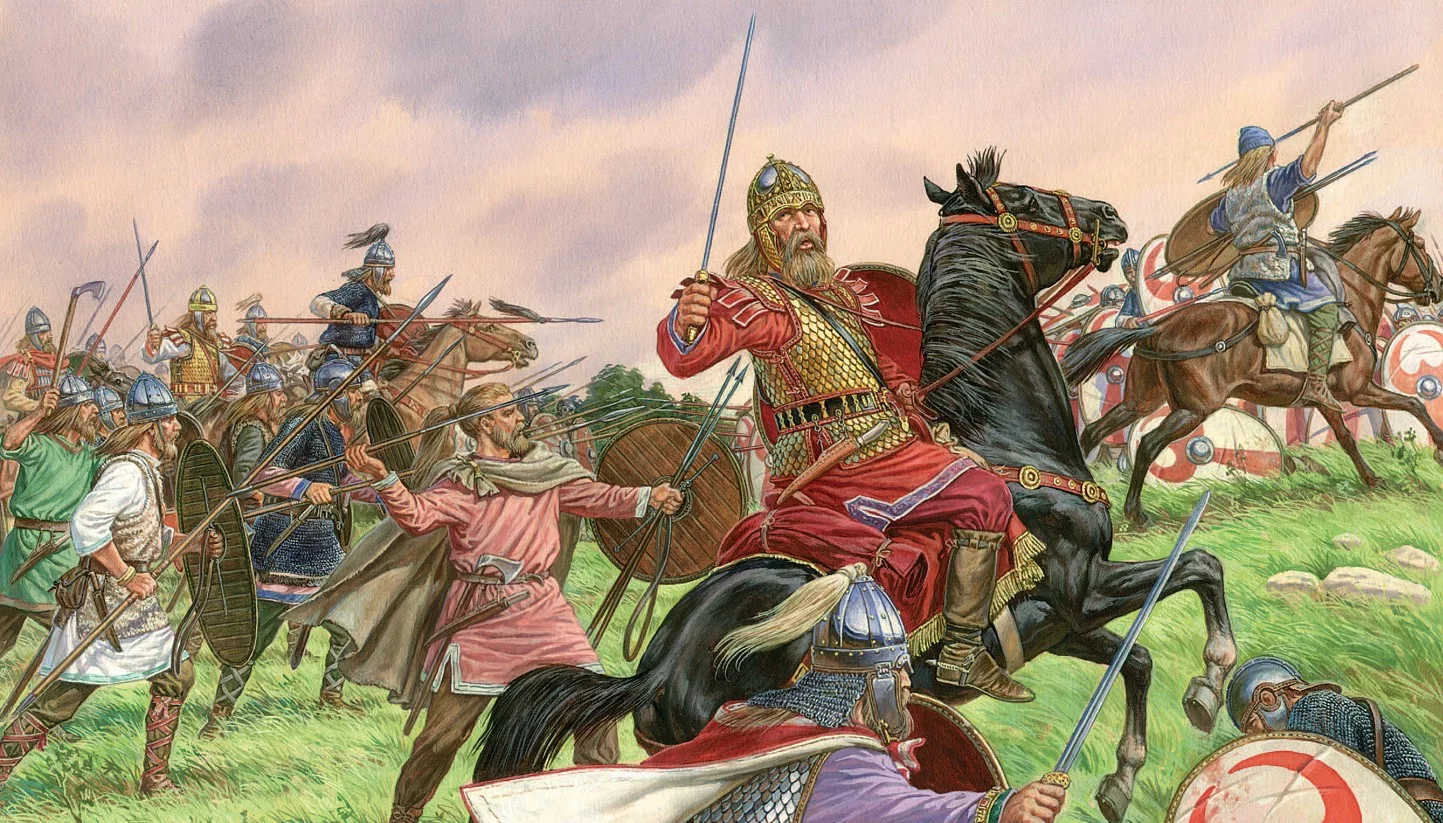
The featured image depicts Germanic warriors in battle, presumably in the Late Roman period. Unfortunately, I am uncertain who to credit. The image seems to have been used as box art for a set of military models ca. 2008. It was also used as the cover image for a book in Greek on barbarians published the same year. It was also later uploaded to a few DeviantArt accounts, but not by the original artist, as far as I am aware.



No Comments