


The Empire That Ate Cinema, part one: Who Owns the Global Box Office?
Spider-Man: Brand New Day has done something extraordinary. In a little over two months, it has earned more than $2.5 billion worldwide, overtaken Titanic and Ne Zha 2, and climbed to third place on the all-time box-office chart. Only Avengers: Endgame and Avatar remain above it. At this stage, catching Avatar looks unlikely, but the fact that it ever became a credible conversation is remarkable in itself.
Two and a half billion dollars is the kind of number that becomes abstract as soon as you say it. It is too large to picture and too detached from ordinary experience to mean much on its own. What gives it weight is everything a film has to do to reach it. One gigantic opening weekend will not get you there. Neither will one country, one fanbase, or a few weeks of hype. A film has to keep drawing people in after the initial rush has passed, hold that attention across dozens of markets*, and keep finding new audiences while most releases around it are already beginning to disappear.
*which makes Ne Zha 2’s achievement all the more incredible.
Plenty of films make hundreds of millions. Far fewer reach a billion. Only a handful have ever gone beyond two. By the time a film reaches that level, it has already separated itself from everything else released in its lifetime.
The strange thing is how inevitable those films look once they are there. Avatar. Endgame. Titanic. Star Wars. Their titles arrive carrying everything that followed them, as though the scale of their success had always been obvious from the beginning.
There was a night before anyone had seen Star Wars. A weekend when Titanic was still the ruinously expensive new James Cameron film nobody quite knew what to make of. A first audience sat down for Avatar not knowing whether the Na’vi were about to redefine blockbuster cinema or become one of its most expensive embarrassments. History has a way of sanding the uncertainty off these moments. Once these films become phenomena, it becomes difficult to remember that there was ever a point when they might not have.
Go back far enough and the machinery behind those successes slowly begins to fall away. The industrial scale contracts, films shorten, exhibition becomes more improvised, and eventually even cinema itself loses the shape we recognise. The more we travel back in time, the less useful our modern idea of a film becomes. What remains is the much older idea underneath it: the attempt to make a still image move.
The Moving Picture
That fascination with movement reaches much further back than cinema itself. Some Palaeolithic cave paintings show animals with repeated legs or overlapping forms, as though a single image was being asked to contain more than one moment at once. Thousands of years later came optical toys that made drawings spin, flicker and blur into motion. The tools changed, but the impulse did not.
Photography finally allowed movement to be captured from real life. Eadweard Muybridge’s famous studies of a galloping horse broke a stride into individual instants, revealing positions the eye could never isolate on its own. By the 1890s, inventors in several countries were finding ways to put those instants back into motion and project them before an audience. The Lumières had their Cinématographe, the Skladanowskys their Bioscop, Robert Paul his Theatrograph. Within a few years moving pictures were appearing in theatres, music halls and fairgrounds across Europe.
What appeared on those early screens was often taken straight from life. Workers left a factory. Waves broke against rocks. A train pulled into a station. The remarkable part was that the moment no longer had to disappear once it had happened. A train could arrive again. People could watch themselves, their streets and their cities moving after the original moment had long since passed.
Georges Méliès saw something else in it. A magician before he became a filmmaker, he treated the camera less like a recorder and more like an extension of stage magic. Substitution splices made people vanish. Multiple exposures filled the frame with impossible doubles. Sets shifted, bodies transformed and scenery behaved in ways reality never could. Then came A Trip to the Moon in 1902, firing astronomers across space from a giant cannon, surrounding them with elaborate painted worlds and visual trickery before driving their capsule straight into the eye of the Moon. For an audience still getting used to the fact that pictures could move at all, Méliès was already showing them places that could only exist on film.
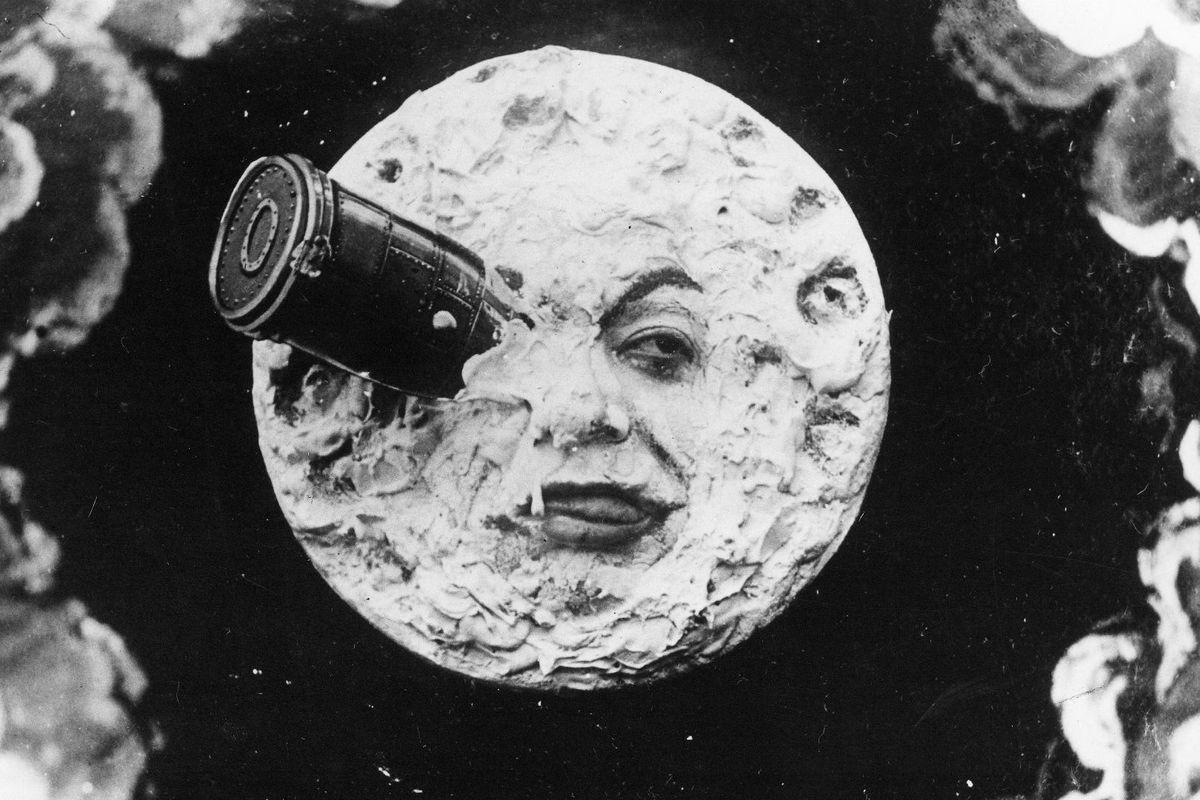
The iconic moon shot from Georges Méliès’ A Trip to the Moon.
Audiences kept coming, and the films kept getting longer. Through the rest of the 1900s, moving pictures escaped the fairground and music hall for permanent cinemas of their own, while stories that had once lasted minutes began stretching towards an hour and beyond. By the 1910s, even the language had caught up with how ordinary the new medium was becoming. Moving Pictures had become ‘movies’, and the people appearing in them were becoming ‘movie stars’.
By 1915, cinema had become large enough for money to enter the story proper. The Birth of a Nation ran for more than three hours and brought together close-ups, cross-cutting, enormous battle scenes and sprawling narrative filmmaking with an ambition audiences had scarcely seen before. It was advertised accordingly, with unusually high ticket prices and the air of an event rather than just another programme at the pictures. What D.W. Griffith chose to do with that ambition was viciously racist, turning the American Civil War and Reconstruction into white-supremacist mythology and portraying the Ku Klux Klan as heroes. The controversy followed the film wherever it went, but so did audiences. Early box-office records are difficult to compare directly, yet Griffith’s own records put worldwide distributor earnings at $5.2 million by 1919, with later estimates of its actual box-office gross running far higher. Nothing before it had operated on quite the same commercial scale.
That benchmark lingered into the 1920s as everything around it grew more extravagant. Movie palaces held thousands beneath ornate ceilings, stars became famous far beyond the countries in which their films were made, and productions kept finding new ways to look expensive. The Big Parade became one of the defining hits of the silent era in 1925, earning almost $5 million in North American rentals on its initial release and millions more overseas. That same year, Ben-Hur: A Tale of the Christ filled the screen with enormous sets, thousands of extras and a chariot race that still looks dangerous a century later.
The Advent of the ‘Talkie’
The Jazz Singer was not the first film to use synchronised sound, and most of it was still silent, but its success in 1927 proved audiences would turn out for films that could speak. Studios began shifting production towards sound, while cinemas installed the equipment needed to play it. The change was remarkably swift. Within only a few years, an industry that had spent three decades learning how to tell stories without speech had made silence the exception. For a short while, sound films were distinct enough to need their own label. ‘Talking pictures’ became ‘talkies’.
By the early 1930s, the novelty of sound was already wearing off. The talkie had simply become the film, and filmmakers were beginning to work out what this new version of cinema could do. Chaplin, characteristically, went the other way. City Lights arrived in 1931 with a synchronised score and effects but no spoken dialogue, years after Hollywood had begun abandoning silence, and still became one of the biggest successes of his career. The old cinema had not vanished quite as cleanly as the industry might have liked.
Elsewhere, sound was helping create new kinds of spectacle. Universal’s Frankenstein turned Boris Karloff’s creature into an image that would far outlive the film, while King Kong spent 1933 putting a giant stop-motion ape on top of the Empire State Building. Its effects were extraordinary for the time, but so was the novelty of the idea: audiences were increasingly being sold things they could not possibly see anywhere except inside a cinema.
Then Disney attempted something many in Hollywood thought absurd. Snow White and the Seven Dwarfs was a feature-length animated film at a time when animation was still largely associated with shorts, expensive enough during production to earn the dismissive nickname “Disney’s Folly”. When it opened in 1937, the folly became a phenomenon. It earned more than $8 million during its initial international release, briefly becoming the highest-grossing sound film ever made. For the first time, animation was competing at the very top of the box office.
It would not stay there for long. Just two years later, Gone with the Wind arrived with a level of anticipation few films before it had ever generated. Margaret Mitchell’s novel had already sold millions, the search for Scarlett O’Hara had become a public spectacle of its own, and Clark Gable was one of Hollywood’s biggest stars. When the film finally opened in December 1939, audiences were met with nearly four hours of lavish Technicolor production, from the burning of Atlanta to vast scenes of wounded soldiers, built around the same romanticised vision of the Old South that had made the novel such a success.
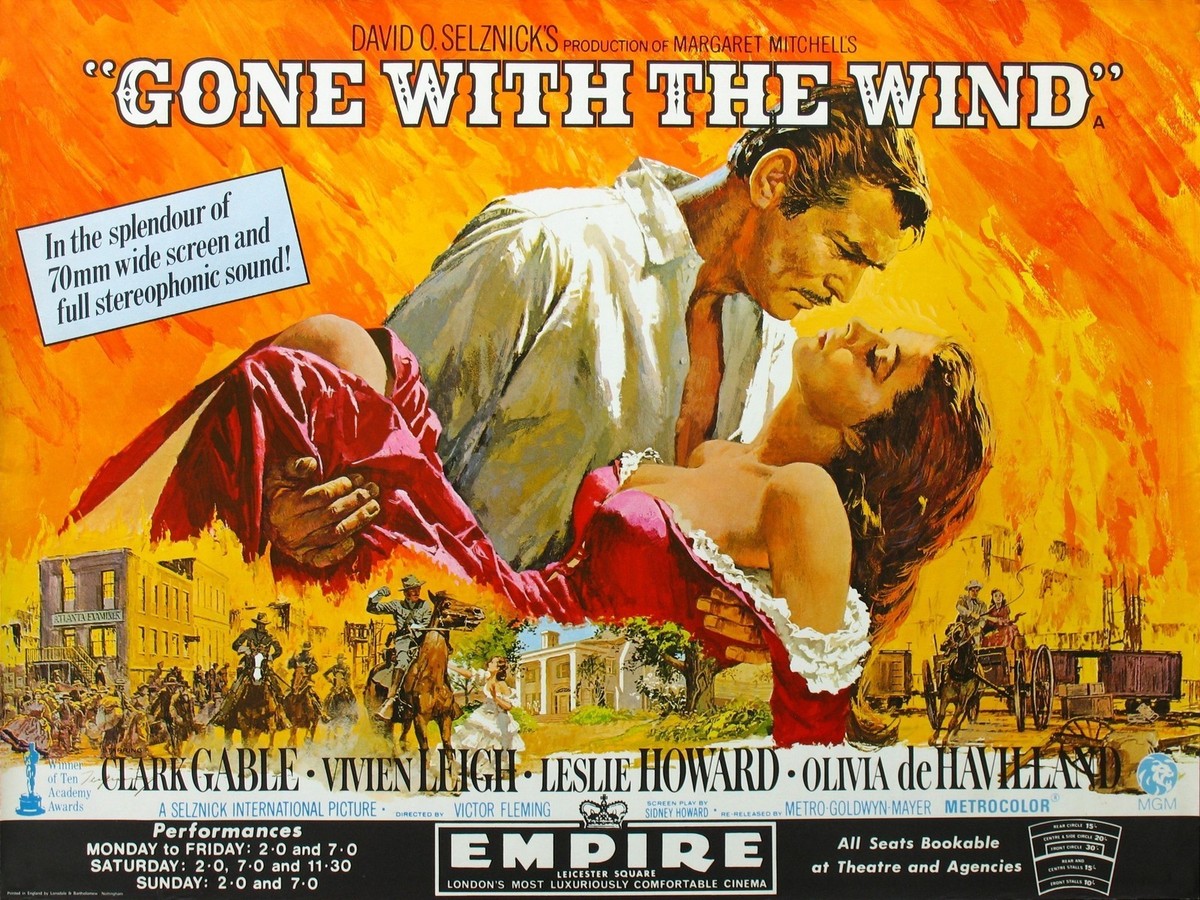
Promotional poster for Gone With The Wind.
The result dwarfed what had come before. By May 1940, its premium-priced roadshow engagements alone had grossed around $20 million. Yet even that was only the beginning. Gone with the Wind returned to cinemas repeatedly for decades, with its 1967 reissue alone grossing around $68 million, building its eventual box-office total across generations rather than in a single theatrical run.
Those numbers come with an important complication, however. For much of cinema history, box-office reporting was anything but standardised: one figure might record the money paid at the ticket window, another only the distributor’s share, while reissues could keep adding to a film’s total for decades.
The 1940s never came close to dislodging Gone with the Wind. In 1946, The Best Years of Our Lives found an enormous audience by turning the experience of returning servicemen into a story millions were living themselves, becoming the biggest conventional Hollywood success since 1939. Stranger still was Mom and Dad. Made cheaply, denied a Production Code seal and sold through sensational roadshow advertising, the 1945 sex-hygiene film turned controversy into an attraction and reportedly earned around $16 million in distributor rentals. One of the decade’s biggest commercial successes had come without stars, spectacle or prestige.
By the 1950s, television was competing for the same evenings cinema once had largely to itself, yet audiences were still turning out in huge numbers when the right film came along. Disney found them repeatedly with Cinderella, Peter Pan and Lady and the Tramp, making feature animation a dependable presence among the decade’s biggest successes. The other answer was to give the cinema screen everything television could not contain. The Ten Commandments built towards the parting of the Red Sea on an incredibly large scale in 1956, and three years later a new Ben-Hur went further still, filling the screen with armies, monumental sets and its famous chariot race. The biggest films were increasingly selling the experience of seeing them as much as the stories themselves.
The 1960s did not abandon that appetite for scale so much as scatter it in different directions. Disney opened the decade with One Hundred and One Dalmatians, another enormous animated success, while Lawrence of Arabia took the widescreen epic about as far as it could go, turning the desert landscapes into the attraction. Then came Bond. Dr. No introduced Sean Connery’s version of the character in 1962, From Russia with Love pushed him further internationally the following year, and by Goldfinger in 1964 the series had become something cinema had rarely seen before: a blockbuster audiences were already primed to return to. From Russia with Love took roughly $79 million worldwide; Goldfinger followed with around $125 million. The franchise itself was becoming part of the draw.
Then The Sound of Music went considerably further. Released in 1965 with Julie Andrews, familiar Rodgers and Hammerstein songs and all the trappings of a lavish roadshow epic, it stayed in cinemas for years and broke box-office records across dozens of countries. By 1966 it had overtaken Gone with the Wind to become the highest-grossing film ever, eventually taking around $286 million worldwide. Disney was still producing enormous hits with The Jungle Book in 1967, while 2001: A Space Odyssey arrived a year later and turned spectacle into something stranger, slower and more technically audacious. By the end of the decade, the biggest films could be animation, spy adventures, musicals or cerebral science fiction. The numbers were climbing, but there was no longer one obvious route to the top.
The 1970s began with another change at the top. Gone with the Wind had reclaimed the all-time record through reissues in 1971, only for The Godfather to take it away again the following year, eventually earning around $250 million worldwide. A bestselling novel, extraordinary performances and the sheer confidence of Coppola’s filmmaking turned a crime story into one of the decade’s defining cultural events. Then came The Exorcist, which became one of the decade’s biggest hits, with reports of fainting, protests and queues only adding to the phenomenon.
Birth of The Blockbuster
The record changed hands again in 1975. Universal opened Jaws across more than 400 cinemas and backed it with a national television campaign, bringing an intensity to its release that was still unusual for Hollywood. The film was suddenly the thing people were talking about that summer, queues built, repeat viewings followed, and before long it had overtaken The Godfather as the highest-grossing film ever. Across its theatrical life, it would push towards $500 million worldwide.
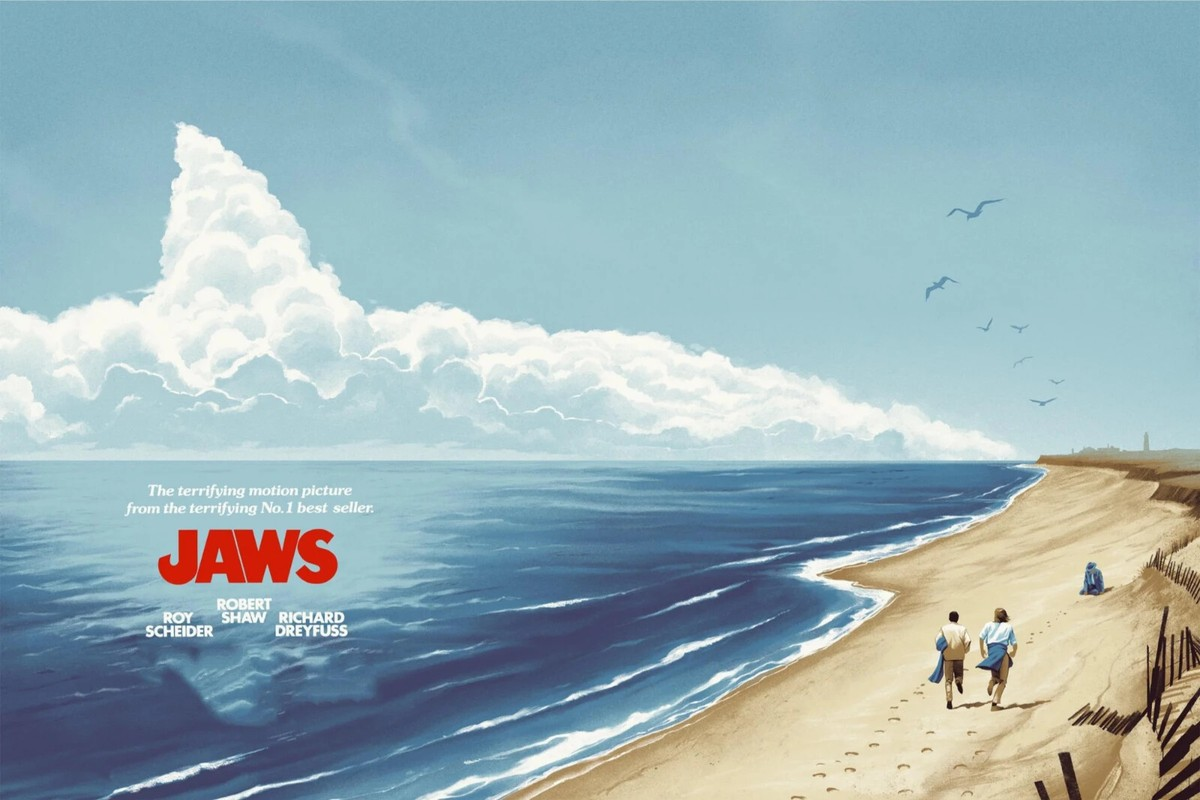
Promotional artwork for Steven Spielberg’s Jaws.
Star Wars arrived in 1977 with effects unlike anything audiences had seen at that scale, but the greater attraction was the world around them. It seemed to continue beyond the edges of the film, giving audiences characters, places and stories they desperately wanted more of. People went back to see it again, then carried it home through toys and merchandise while anticipation began building for whatever came next. Star Wars took the all-time record from Jaws and would eventually pass $700 million across its theatrical releases. A blockbuster could now keep growing long after the audience had left the cinema.
By the beginning of the 1980s, the numbers themselves were becoming easier to trust. Centralised reporting of actual ticket grosses was replacing the older patchwork of distributor rentals and partial estimates, bringing box-office reporting much closer to the system used today.
The decade immediately showed how durable the new blockbuster model had become. The Empire Strikes Back and Return of the Jedi proved audiences would return to Star Wars in enormous numbers, while Raiders of the Lost Ark gave Lucas and Spielberg another major franchise. But it was Spielberg alone who took the record next. E.T. The Extra-Terrestrial arrived in 1982 with no existing property behind it and grew into an extraordinary word-of-mouth phenomenon. It overtook Star Wars as the highest-grossing film ever and would eventually approach $800 million worldwide across later releases. Ghostbusters, Back to the Future and Top Gun became major hits as the decade continued, but none displaced it until 1993.
The 90s pushed the numbers into another league. In 1993, Spielberg incredibly beat his own record when Jurassic Park overtook E.T. The dinosaurs were the attraction, but the shock was how convincing they looked: for the first time, audiences could watch creatures that had been extinct for millions of years move with a physical realism that seemed impossible. The film finished its original run with more than $900 million worldwide, falling just short of the billion-dollar mark it would later cross through reissues. The Lion King became another enormous Disney success soon after, while Independence Day turned alien invasion into one of 1996’s defining global hits.
In 1997, Titanic began an unprecedented box-office run. Cameron had rebuilt the ship at near full scale and spent hours letting audiences live aboard it before the sinking began. By then, DiCaprio was suddenly everywhere, while Jack and Rose permanently lodged themselves in popular culture. The film opened to $28.6 million in North America, rose to $35.5 million in its second weekend, and then simply refused to disappear, holding number one for fifteen consecutive weekends. New audiences were still discovering it months after release while huge numbers went back for a second or third viewing. Titanic passed Jurassic Park, became the first film ever to cross $1 billion worldwide and finished its original run above $1.8 billion. The record nearly doubled.
The Age of The Franchise
With the new millennium came a box office increasingly dominated by familiar names. Titanic remained out of reach, but the decade’s biggest releases were increasingly clustering around the billion-dollar mark. Multiple Harry Potter films sat among the biggest releases of their years, while The Lord of the Rings grew with each instalment until The Return of the King passed $1 billion worldwide in 2003. Together, the trilogy had become one of the largest cumulative theatrical events of the decade. Shrek, Star Wars and Pirates of the Caribbean kept returning to the top end of the box office, with Dead Man’s Chest also crossing $1 billion, before The Dark Knight did the same in 2008. By then, the box-office was increasingly being fought over by worlds audiences already knew.
In 2009, Avatar took audiences to Pandora. For nearly three hours, its world existed around you, its forests, creatures and Na’vi sharing the same physical space with a consistency cinema had never before achieved at that scale. CGI, performance capture and stereoscopic 3D were nothing new, but Avatar pushed all three beyond their existing limits, developing new virtual-production and camera technology along the way. Cameron fused it all so completely that the technology disappeared into the experience. More than two thirds of the film’s gross came from outside North America. Avatar first overtook Titanic, ending its twelve-year reign at the top, then became the first film ever to cross $2 billion worldwide. And it kept going. And going. By the end of its original theatrical run, it had reached roughly $2.74 billion, leaving the previous record holder almost a billion dollars behind.
The 2010s belonged to established IP. From Toy Story 3 in 2010 to Endgame in 2019, every yearly number one bar Frozen came from a pre-existing property. Harry Potter concluded its eight-film run in 2011, before The Avengers brought several Marvel series together and took more than $1.5 billion worldwide. The crossover itself was the attraction. The Force Awakens went further in 2015, putting Star Wars back on the big screen and passing $2 billion.
Then Marvel cashed in a decade of investment. Infinity War brought together characters audiences had followed separately for years, crossed $2 billion and left them waiting a year for the conclusion. Endgame followed with twenty-one films and eleven years of attachment behind it. Its opening weekend alone took more than $1.2 billion worldwide, before the film climbed to roughly $2.8 billion and took the all-time record from Avatar. The biggest film in history was now the twenty-second chapter of a story that had started eleven years earlier.
The pandemic tore through the theatrical box office in 2020. Cinemas closed across the world, releases vanished from schedules, and Demon Slayer: Mugen Train ended the year on top with roughly $500 million, less than half what the biggest films had been taking only a few years earlier. The wider industry would take years to recover, but individual films found their way back sooner. Avatar reclaimed the all-time record from Endgame through a Chinese re-release in 2021, Spider-Man: No Way Home reached $1.9 billion later that year, and Avatar: The Way of Water followed with more than $2.3 billion in 2022.
In 2025, Hollywood’s grip on the very top finally broke. Ne Zha 2 passed $2 billion and eventually reached around $2.27 billion, with roughly 97 per cent of that coming from mainland China. Hollywood’s $2 billion films had assembled their totals across dozens of countries. Ne Zha 2 did it almost entirely at home. Meanwhile, Avatar and Endgame continued trading the all-time record through re-releases, their fight at the top stretching into 2026.

Ne Zha faces the surging waters in Ne Zha 2.
More than a century after moving pictures first flickered onto screens, what exactly has been sitting at the top?
The answer, overwhelmingly, is Hollywood.
The first moving pictures emerged across Europe and America, from French factories and German music halls to British racecourses. Méliès sent his astronomers to the Moon from Paris. Yet follow the films that went on to command the largest audiences and, decade after decade, the story narrows. The Birth of a Nation. Gone with the Wind. The Godfather. Jaws. Star Wars. E.T. Jurassic Park. Titanic. Avatar. Endgame. Different genres, different generations and radically different ways of getting there, but the commercial summit has remained overwhelmingly in the hands of the American film industry. Ne Zha 2 matters precisely because after more than a century, its presence looks so unusual.
Genres changed. Technologies changed. Business models changed.
How did something so international come to be dominated so thoroughly by Hollywood?
Sources and further reading
Box-office figures, rankings, worldwide grosses and record changes throughout were checked primarily against Box Office Mojo, with The Numbers used as a supplementary source. Historical figures were cross-checked against archival and contemporary sources where necessary. Early box-office reporting is not always directly comparable with modern grosses, particularly where figures record distributor rentals rather than ticket sales or include later reissues.
Box Office Mojo – worldwide all-time box-office rankings and lifetime grosses. Box Office Mojo: Top Lifetime Grosses
The Numbers – supplementary worldwide box-office figures and historical release data. The Numbers: All-Time Worldwide Box Office
Marc Azéma and Florent Rivère, “Animation in Palaeolithic Art: A Pre-Echo of Cinema”, Antiquity – Palaeolithic representations of movement using repeated and superimposed animal forms. Cambridge University Press: Animation in Palaeolithic Art
BFI / Sight and Sound, “In the Beginning: Cinema’s Murky Origin Story” – the international origins of projected cinema, including the Lumières, Robert Paul, Birt Acres and the Skladanowskys. BFI: In the Beginning: Cinema’s Murky Origin Story
BFI, Georges Méliès – Méliès’ background in stage magic, early trick filmmaking and A Trip to the Moon. BFI: Georges Méliès on his early struggles in cinema
Gorham Kindem, ed., The International Movie Industry – historical material on the early American film industry, including contemporary earnings records associated with The Birth of a Nation. Google Books: The International Movie Industry
Library of Congress, National Film Registry – The Jazz Singer, Vitaphone and the arrival of synchronised spoken dialogue in feature films. Library of Congress: National Film Registry essays
BFI, “The Story of Disney in 11 Films” – Snow White and the Seven Dwarfs, the “Disney’s Folly” nickname and its commercial success as the first feature-length cel-animated film. BFI: The Story of Disney in 11 Films
American Film Institute Catalog, Gone with the Wind – production and release history, including its original roadshow performance and contemporary reporting. AFI Catalog: Gone with the Wind
American Film Institute Catalog, Jaws – production history, early box-office performance and its importance to the development of the modern summer blockbuster. AFI Catalog: Jaws
Los Angeles Times, contemporary Titanic reporting – Titanic’s extraordinary repeat-viewing run and sustained position at the top of the North American box office. Los Angeles Times: Titanic Refuses to Sink, Passes Star Wars
Autodesk, “Avatar: Autodesk Software Core to Realization of James Cameron’s Creative Vision” – the virtual-production, performance-capture and real-time filmmaking technology developed and refined for Avatar. Autodesk: Avatar virtual filmmaking
The Walt Disney Company, “Avengers: Endgame Makes History with $1.2 Billion Global Debut” – Endgame’s record $1.209 billion worldwide opening weekend. Disney: Avengers Endgame $1.2bn global debut
Reuters, Ne Zha 2 reporting – the film’s extraordinary performance in mainland China and its place within the Chinese box-office market. Reuters: Ne Zha 2 becomes China’s highest-grossing film
The Guardian / Box Office Mojo – the 2026 Avengers: Endgame re-release and subsequent change at the top of the worldwide all-time box-office chart. The Guardian: Avengers Endgame re-release



No Comments