
Coyote vs. Acme Refuses to be Written Off – A Review
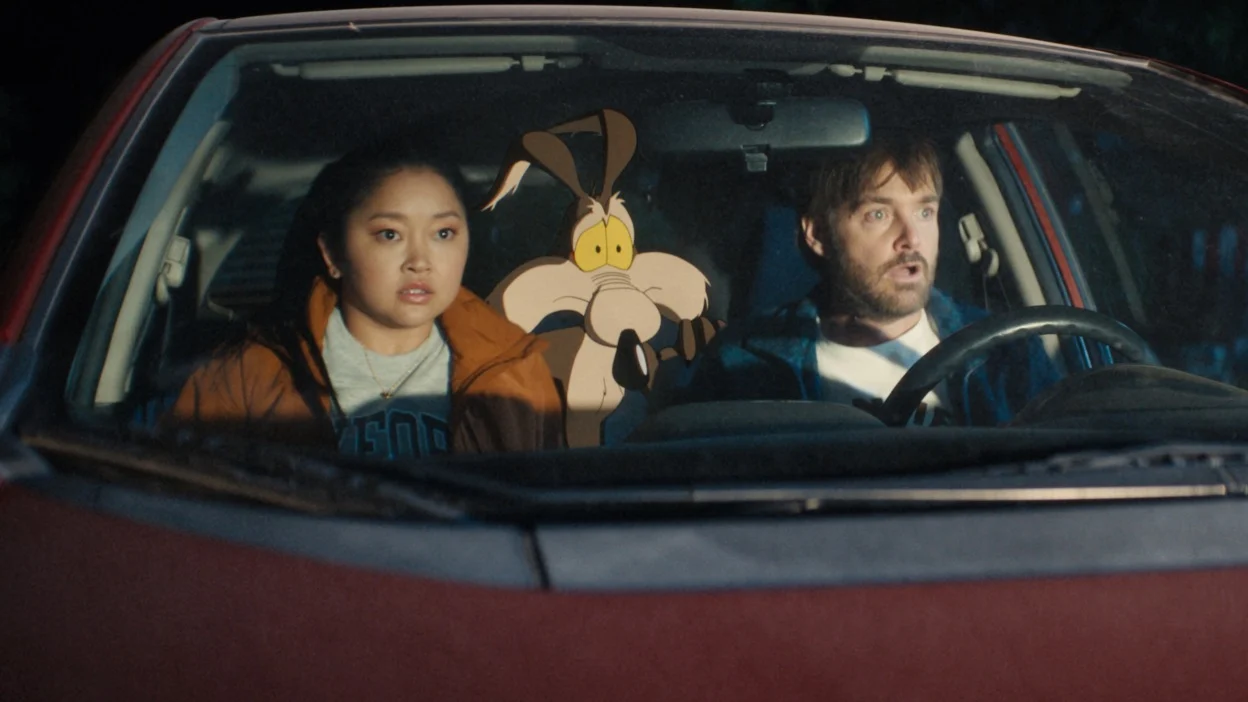
For seventy-seven years, Wile E. Coyote has been falling. The ground cracks beneath his feet, rockets double back and every road ends with that small white bloom of dust at the bottom of a canyon. Coyote vs. Acme finally allows him to land. He walks into a human law office and nobody asks what a cartoon is doing there. They ask whether he has a case. Almost four decades after Who Framed Roger Rabbit, Dave Green understands that the humans must accept the cartoon before the audience can. Human hands meet animated bodies with convincing resistance, while real spaces absorb the force of every impossible collision. Green has made reality answer when the cartoon touches it.
Outside the film, Warner Bros. tried to deny him that existence altogether. Coyote vs. Acme had been completed at a reported cost of around $70 million when the studio attempted to shelve it as part of a tax write-off. Reports of strong test screenings magnified the absurdity; completion had already created the obligation to release it. Once hundreds of people have carried a production across the line, the finished work belongs in public. A film locked inside a vault becomes an invisible credit. The artists and technicians who made it cannot place the work before another employer or use it to account for years of their careers. Warner Bros. had taken their labour and meant to deny them the public record of it.
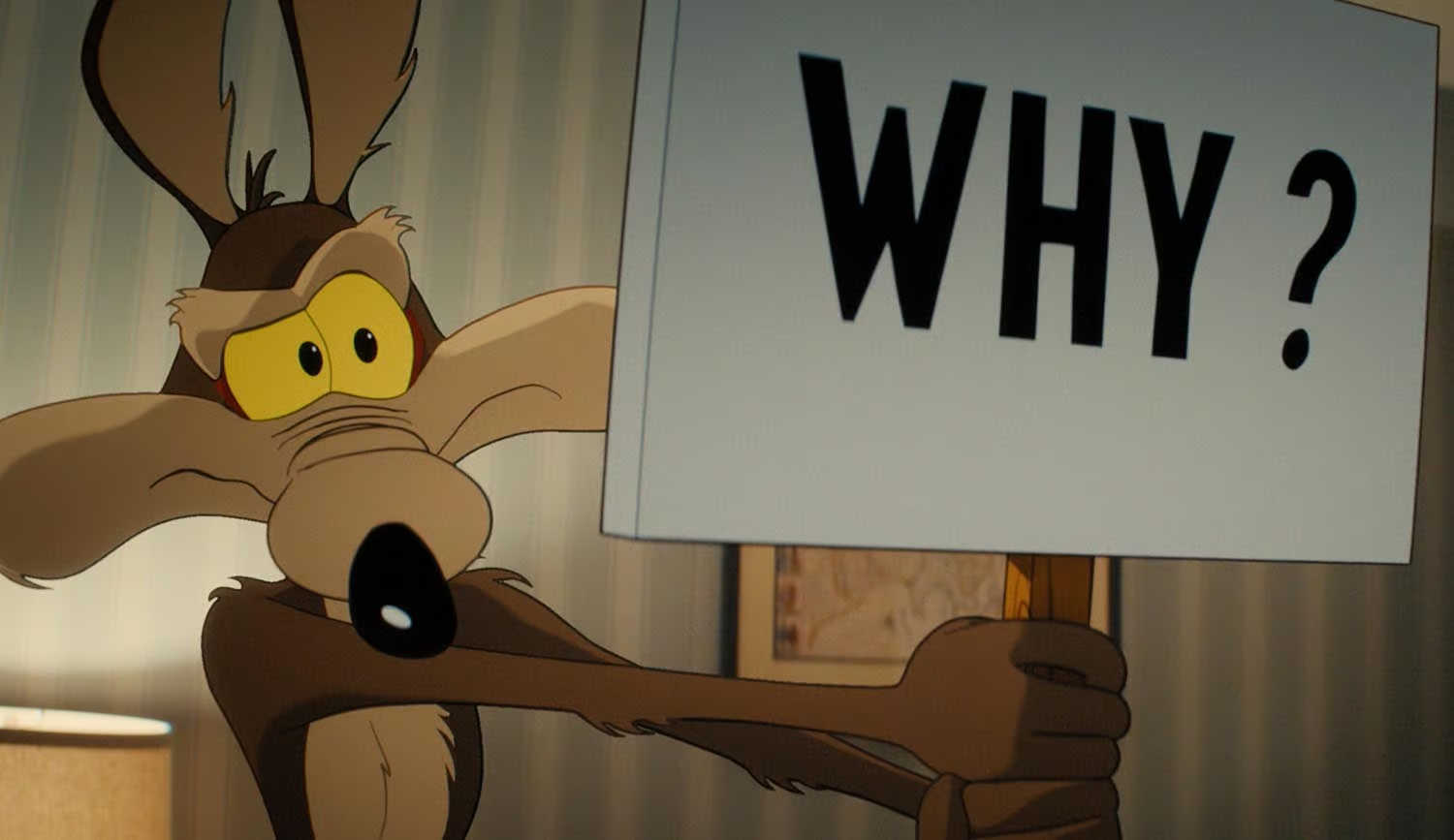
Ketchup Entertainment eventually acquired Coyote vs. Acme and brought it to cinemas. What it rescued was a legal comedy built around an idea so obvious that the cartoons seem to have been heading towards it for decades. After a lifetime of defective rockets and suspiciously volatile explosives, Wile E. hires Kevin Avery, a struggling accident lawyer played by Will Forte, and sues the company that made them. Samy Burch’s screenplay turns every old catastrophe into evidence, with each blast leaving behind another exhibit. A story about a corporation calculating the value of those caught beneath its machinery had spent years trapped inside the arithmetic of its owner.
The unquestioned coexistence of humans and toons gives the comedy its speed. Animated characters enter scenes without fanfare, taking their place in offices and courtrooms while life continues around them. When a toon collides with a person, the reaction travels through both performances and into the room itself. The actors meet the effects with exact eyelines and a sense of resistance, giving the impression that their hands have found something solid. The CGI keeps the characters visibly stylised because their weight does the convincing. Their surfaces belong to animation; their impact belongs to the physical world.
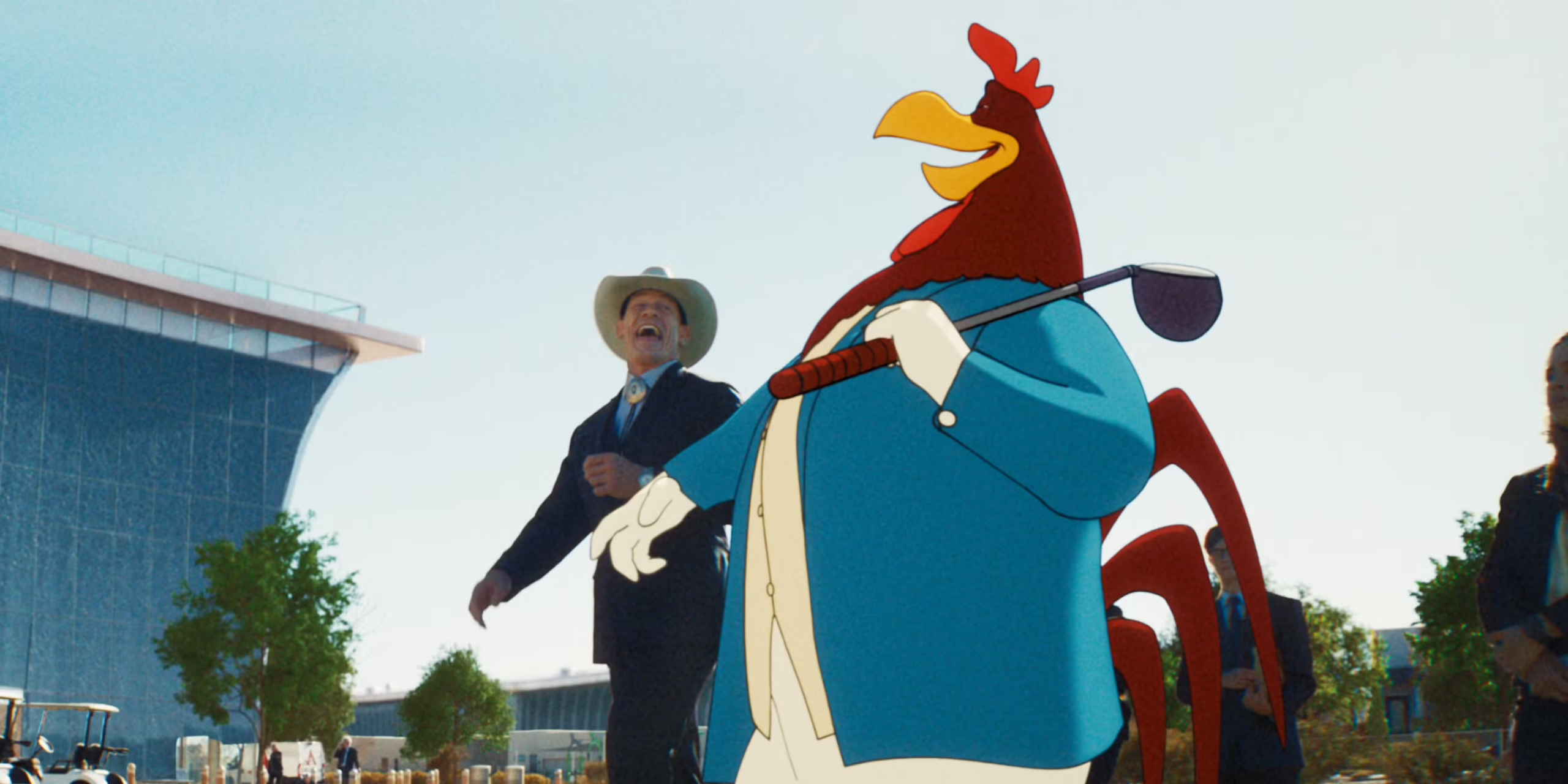
John Cena meets that corporate logic with immaculate teeth and the bearing of a man who has never entered a room without assuming it already belongs to him. As Acme’s lawyer, Buddy Crane turns professional confidence into physical intimidation. His enormous frame gives every confrontation a physical charge, while his willingness to look completely ridiculous keeps bending that threat towards comedy. When Tweety Bird begins explaining what he “tawt” he “taw,” Crane adopts the same mangled syntax and drives the interrogation deeper into nonsense. Cena gives every broken syllable the force of a threat. He enters the cartoon’s language wholeheartedly, meeting its absurdity at full volume and discovering how intimidating nonsense can become when delivered by somebody built like a wall.
Will Forte supplies the ordinariness that Cena and the cartoons can push against. His slightly defeated presence suits Kevin Avery, a billboard lawyer whose career has already settled into mediocrity before a coyote arrives with the case of a lifetime. Kevin recognises Wile E.’s humiliation because failure has already become the atmosphere of his own life, and representing him gradually gives both characters a reason to expect something different. Their relationship carries the story through its strangest turns, giving the legal machinery a personal stake that grows quietly beneath the jokes. A few punchlines are corny enough to creak, and the next gag arrives before the sound has finished.
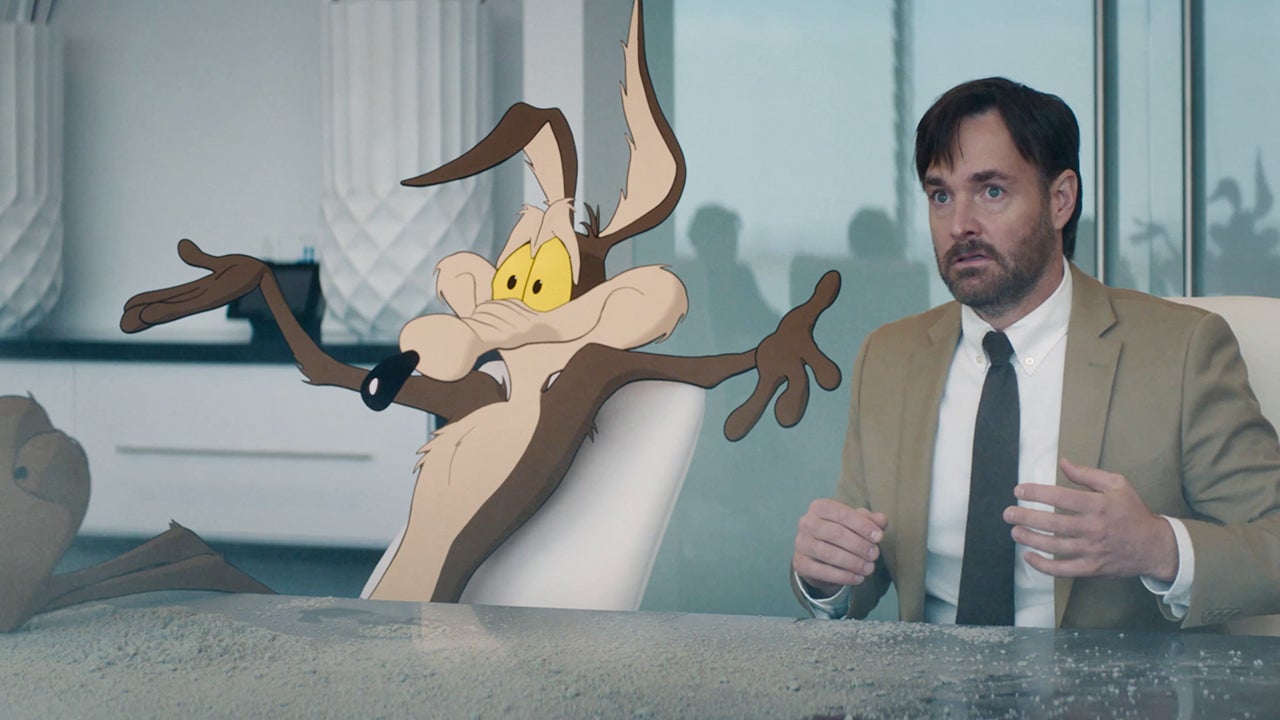
Wile E.’s silence is essential to the film’s emotional life. He communicates through movement, expression and the occasional sign, leaving the animators to find entire arguments in the narrowing of his eyes or the exhausted droop of his body. Forte has to listen to a character who cannot speak, reading the thought inside each reaction before carrying the conversation onwards. That attention gives Wile E. more than physical presence. The film allows decades of failure to gather around him, turning the familiar reset of cartoon violence into something unexpectedly affecting. His body always springs back. The disappointment does not. Beneath the explosions is a character returning to the same desire because persistence is the only language he has ever known.
For years, Coyote vs. Acme existed in public as an industrial scandal, discussed more often as an accounting decision than as somebody’s work. Seen at last, it is a proper studio comedy whose silliness leaves room for something sincere. The slapstick gradually becomes a story, and its battered coyote comes to matter far beyond the joke of his latest explosion. Release was owed the moment Coyote vs. Acme was finished. Its quality merely measures the scale of what Warner Bros. was willing to throw away. If you care about cinema, go and give Coyote vs. Acme the audience Warner Bros. tried to deny it.

No Comments