The Rings of Power Season 3, Episode 6: From Valinor – Recap and Breakdown
Spoiler Warning: This article contains major spoilers for The Lord of the Rings: The Rings of Power Season 3, Episode 6.
Dude, where is my husband?
With her newly-found husband lost again, Galadriel is now on her own hiding from the orc hunting parties. (Pleasingly, we see them wearing cloaks and hoods to keep the sun off, making sure not to forget the well-known light sensitivity we saw in season 1), and has to use the power of her ring Nenya to sooth and divert a tracking warg. The orcs move on, but along comes a Nazgnagôl on a horse, oh no! But it’s Theo, desperate for help to take off his ring of power, saying Sauron lied to him, and that he can’t do it himself. Galadriel looks unconvinced, but when he tries it causes him extreme physical distress. So she obliges, and it slips off relatively easily: no magical superglue here, just mental control over the poor lad. The result seems to still be incredibly painful, and you can see the hunger in Theo’s eyes as he watches Galadriel with his ring.
Theo tells Galadriel that Sauron has Celeborn alive and is going to extract all he might know about the three elven rings from him, even though, as Galadriel says, “he knows nothing”. Galadriel makes to leave, but Theo says he has to come too, if she wants to have any chance of making it to Celeborn.
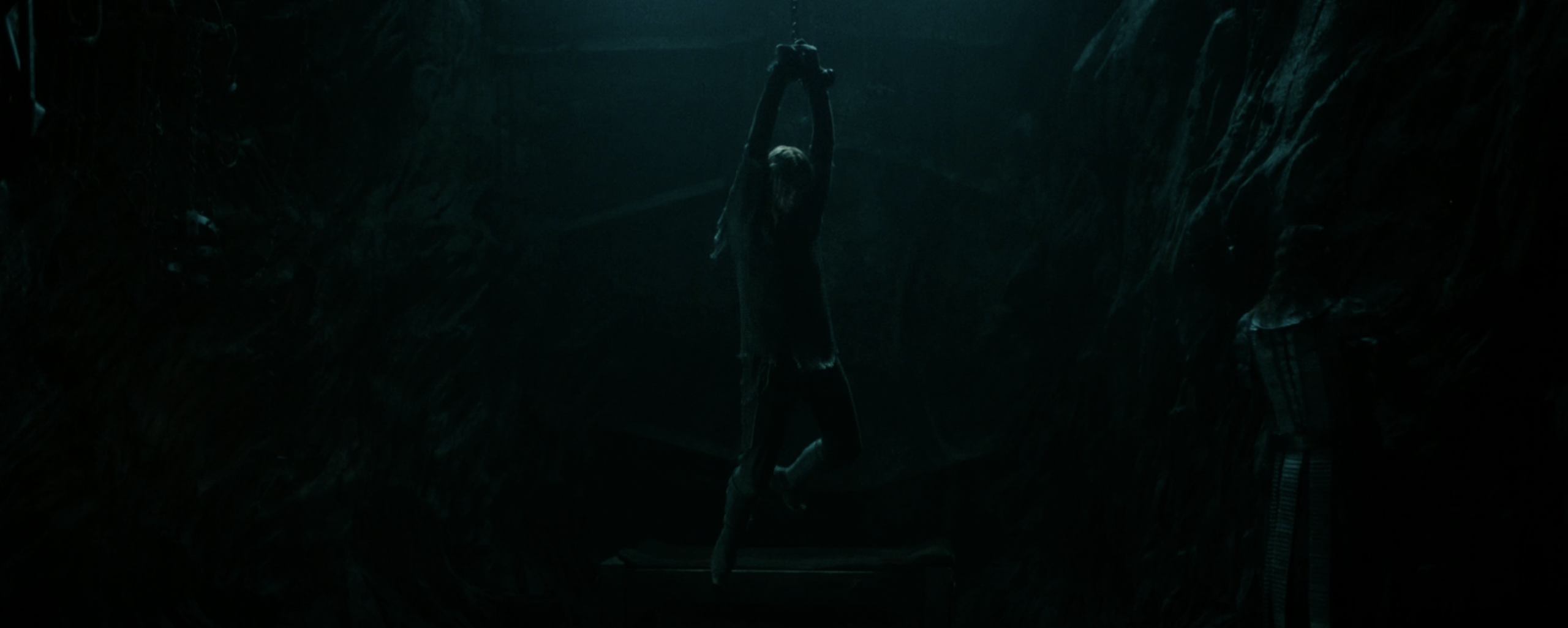
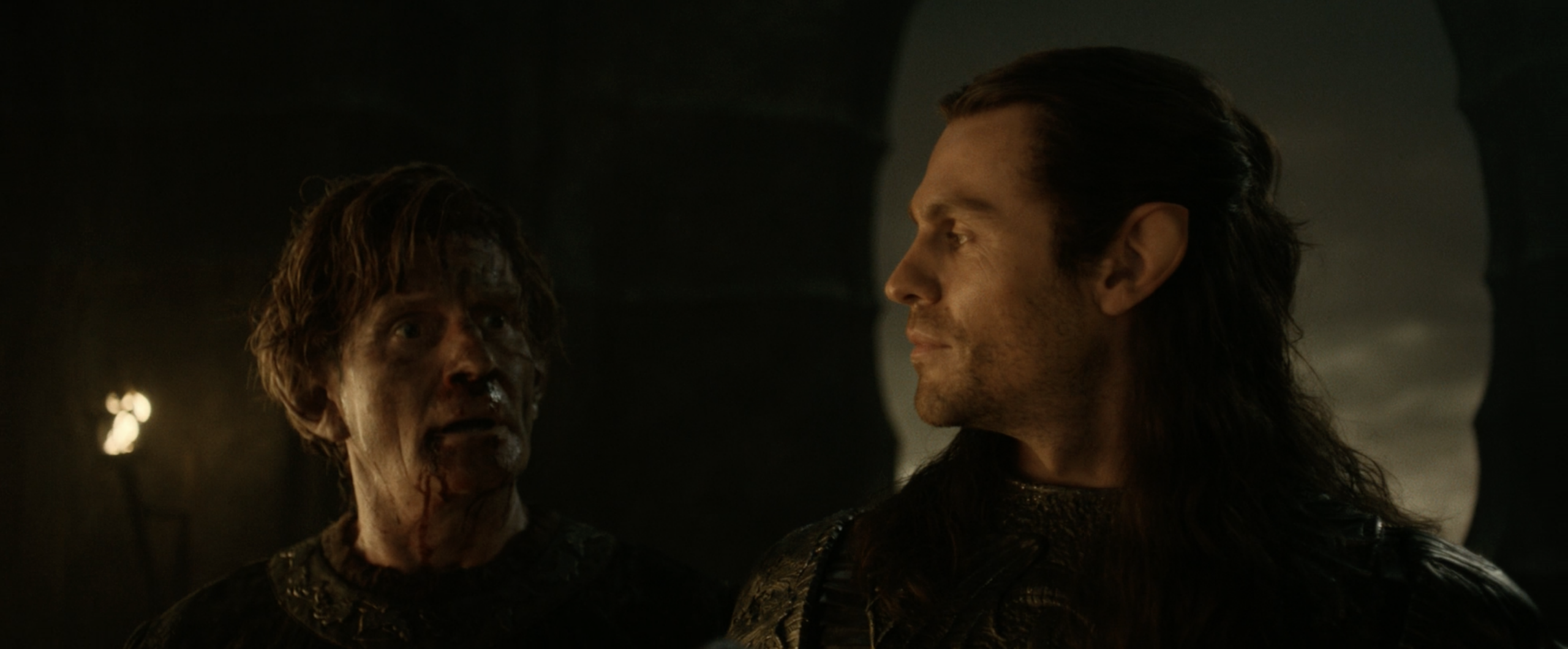
In Barad-dúr’s dungeons, Sauron says he wants Celeborn to tell him in detail everything he knows about the Three, based on spending years as cell-neighbour with the last surviving elven-smith from Eregion. But Celeborn counters with asking why Sauron is doing all of this. Here we get a hint at Tolkien’s deeper writings about Sauron’s character and motivations from volume 10 of History of Middle-earth, Morgoth’s Ring, something it’s clear from interviews Charlie Vickers has read. Sauron explains that the one true bliss is that moment when one being “submits his ….. or her …. will to yours”. And he seeks to have that with all people, for always. In this way, Sauron’s desire for order and control is very much different from Morgoth’s nihilism and desire to destroy what he can’t have. After yoinking Celeborn up to dangle by his manacles, Sauron starts twisting the psychological screws, claiming Galadriel betrayed Celeborn, and didn’t look for him. When Celeborn claims this was because she’d been told he was dead, Sauron counters with the fact that didn’t stop Galadriel chasing after him, with the same information, for century upon century. But still, Celeborn says, Galadriel married the one who promised a hill and some trees, and hasn’t turned up for the being who offered her all of Middle-earth.
Sauron is a bit triggered, and storms out, telling the orcs to ready “the Machine”. A nice little nod to Tolkien’s Letter 131 there, his ten-thousand-ish word essay sent to a publisher explaining his entire mythology across the three ages. In this letter Tolkien explains that it is mainly concerned with the three themes he dubbed “Fall, Mortality, and the Machine”. The last of these is more about magic, or rather
…all use of external plans or devices (apparatus) instead of development of the inherent inner powers or talents — or even the use of these talents with the corrupted motive of dominating: bulldozing the real world, or coercing other wills.
—J.R.R. Tolkien, Letter 131
The Machine
Celebrimbor apparently invented a printing press, but Sauron “improved on the design” so it would “press secrets from men’s souls”; he promises Celeborn that “torture is but the beginning of what you and I are about to share”. It is typical of Sauron to turn something that was intended to be used to create useful and even beautiful things (I love good typography), into an instrument of evil.
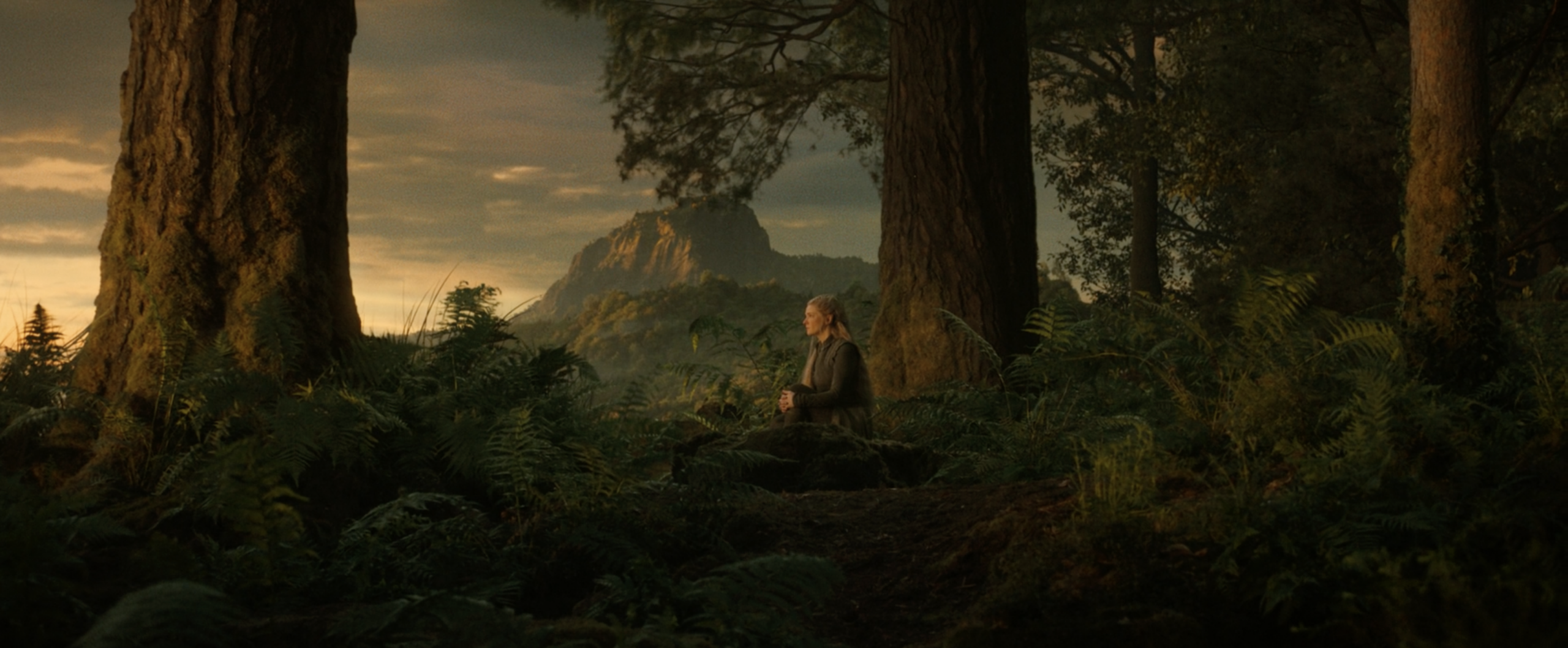
Galadriel and Theo seem to have taken a circuitous route (or else the show is applying the rule of cool) as they have a stop in what we have been hinted to as being the forest later known as Lothlórien. At the very least, it’s a moment of emotional space for Galadriel, as she sings a lamentation, and perhaps might have a bit of a good effect on Theo, though he’s still craving his ring. (it has been confirmed by Morfydd Clark in interviews that Galadriel’s singing was a way for her to grieve for Arondir’s tragic death.)
Unfortunately for Celeborn, he is being slowly pressed under a pile of freshly-cast metal ingots, cast using lava from Mount Doom. Sauron delights in explaining the physiological effects of what will happen, in somewhat painful (to me) detail. But also mock-pleading to be “spared the horror” of seeing Celeborn in the greusome final stages of the process. Celeborn remains defiant, continuing to pushing Sauron’s buttons (a wonderful callback to Adar is made here).
Coals of fire
In Númenor, the tables have turned for Kemen, now prisoner in the carriage he was taking Elendil to the capital in. Anárion is relishing taunting Kemen by eating in front him, before being dismissed by Elendil, who hands over his own rations. When asked by Kemen why he hasn’t already been killed, Elendil responds wryly, “Son of a king is useful company”, showing a level of political and moral maturity that perhaps the King’s Men would have displayed. It’s also nice to see a little bit of historical realism: the release of a prince was bargained for in pre-modern times, rather than just executing them for revenge. But Kemen is extremely confident his father will win, and the leaders of the Faithful hanged in the public square. Anárion is annoyed by Elendil’s treatment of their prisoner, and again when he quotes a saying of Elros: “A gift to one’s enemy is a gift to one’s own soul”. We see both armies arrayed within eyesight of each other, and both are waiting on orders from their respective monarch. No rash attacks here, the pace of communication and politics determines how things proceed.
Elrond meanwhile is still trying to convince Míriel there is another path other than open war, as she is using a very cool tactile map and markers to feel the troop locations. Elrond’s argument is that Ar-Pharazôn actually wants to go after Sauron, and freeing him to do that, and extracting a promise that the Faithful will be protected and not persecuted, aligns with Míriel’s hope of a unified and peaceful Númenor: “No more scattered outcasts. No more children orphaned in the night.” The latter is reminiscent of Tolkien’s earliest writings on Númenor, with overnight political disappearances in the degrading situation under Ar-Pharazôn (then called Tarkalion). Despite (or perhaps because of) Isildur’s urging to take action, Míriel sends off a dispatch.
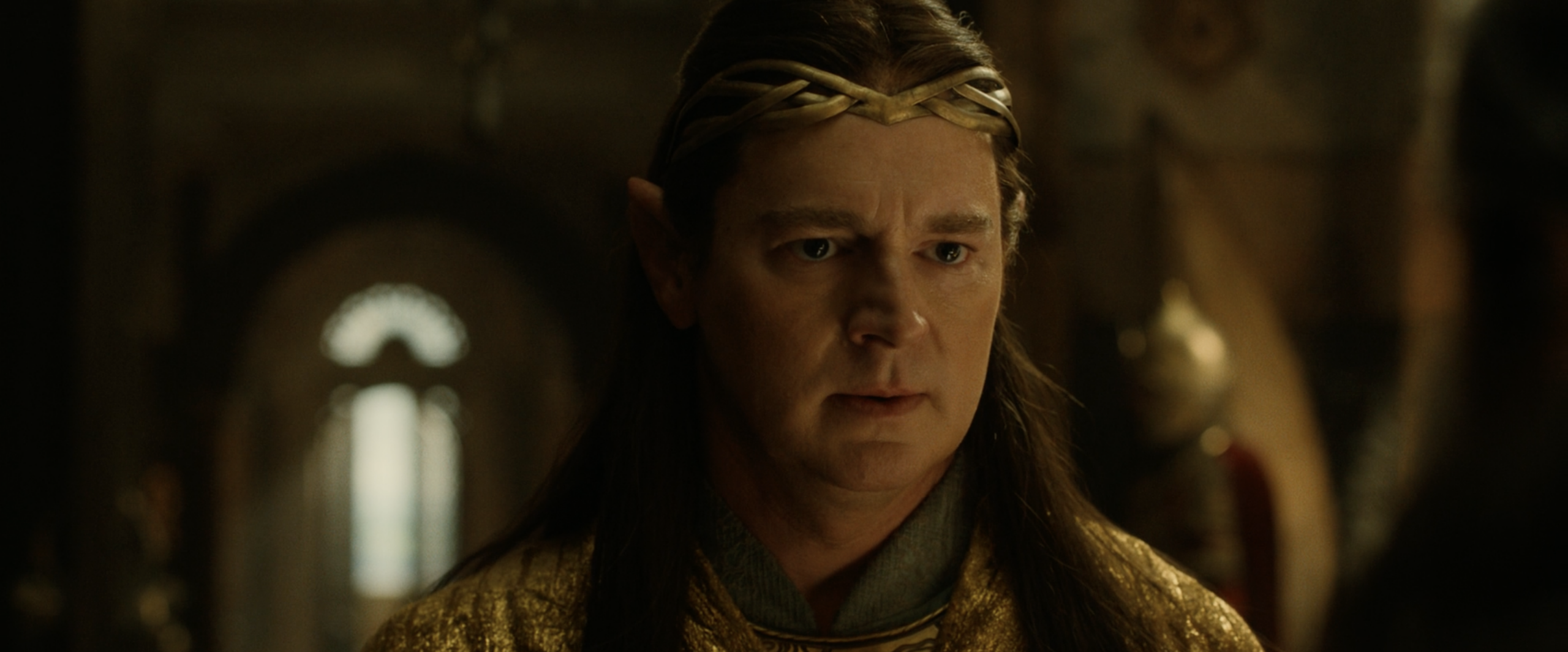
On the other side of the divide, Gil-galad is urging Ar-Pharazôn to just wait a little longer for Elrond’s negotiation skills. He makes some bold claims about how history will see Ar-Pharazôn, and asks him for this favour, to wait, “king to king”, playing to his pride. Luckily, in that moment of hesitation, Míriel’s message arrives, asking for parley.
Hunt for the rings
Now king of Khazad-dûm, Thrain is getting the stone singers to resonate with the mountain to try to find the rings, as his soldiers hunt in more practical means, heedless of personal property. With no success, Thrain wants Disa, the best of them, who has disobeyed his summons. So Thrain goes to have a chat with Durin, in shackles in a cave. We get a little more of their personal history, and that Thrain, despite denying he wanted the throne, and that he just needs the seven dwarf rings, begged his father to not be passed over. Durin senior told his younger son that Thrain would have chosen his own needs over that of the kingdom every time. Durin remains steadfast, and is confident Disa won’t give in even if threatened, but Thrain says he wasn’t thinking of threatening Disa, leaving the threat to the kids unsaid. Thrain definitely seems in the mold of Tolkien’s earlier versions of Dwarves, much less respectable and more like the Petty-dwarves of the First Age.
Disa and the kids are under house arrest, and Thrain, in a very much Godfather-style role, doesn’t even need to explain to his guards what he wants to get them to start heading to her children’s bedrooms. Relenting, Disa sings to locate the rings, and says she has them, and in addition to some guards/miners, Lady Freyja, one of Thrain’s party, goes with her.
Politics: the art of the possible
Back in Númenor, Gil-galad goes to see Míriel, bringing the acceptance letter from Ar-Pharazôn, and despite Isildur’s paranoia, Gil-galad and Míriel are operating on a more political level. Elrond offers a distraction in asking to see his brother’s artifacts with Isildur. And here we the armour Elros was shown wearing in the earlier flashback, and Elrond finds the picture he drew of their mother Elwing that day, now an ancient piece of parchment. These were all among the few things that were saved when the Hall of Lore (seen in Season 1) was torched by the King’s Men. Elrond and Isildur have a continuation of their earlier discussion about Elros, and what Elrond is still missing: his brother’s trust in the Valar, and “the power to let go”, certainly giving Isildur something to think about.
In a private discussion with Gil-galad, Míriel confesses it is “difficult to see the path to victory” when she can’t even see the king as she negotiates with him. And, smiling slyly, Gil-galad uses the power of his ring Vilya to heal Míriel of her blindness. Immensely touched by this gift, but also emboldened, she enters the capital with her own escort, covert soldiers on rooftops, and faces up to Ar-Phrazôn in the public square, as agreed, side by side with the Elven High-King (in, I must say, really wonderful long tracking shot of the approach through the streets, symbolic perhaps of Míriel’s newly restored sight?) Ar-Pharazôn is unsettled, and Belzagar wants to pull out, but after a tense moment, politics prevail, and the royal cousins have a private chat.
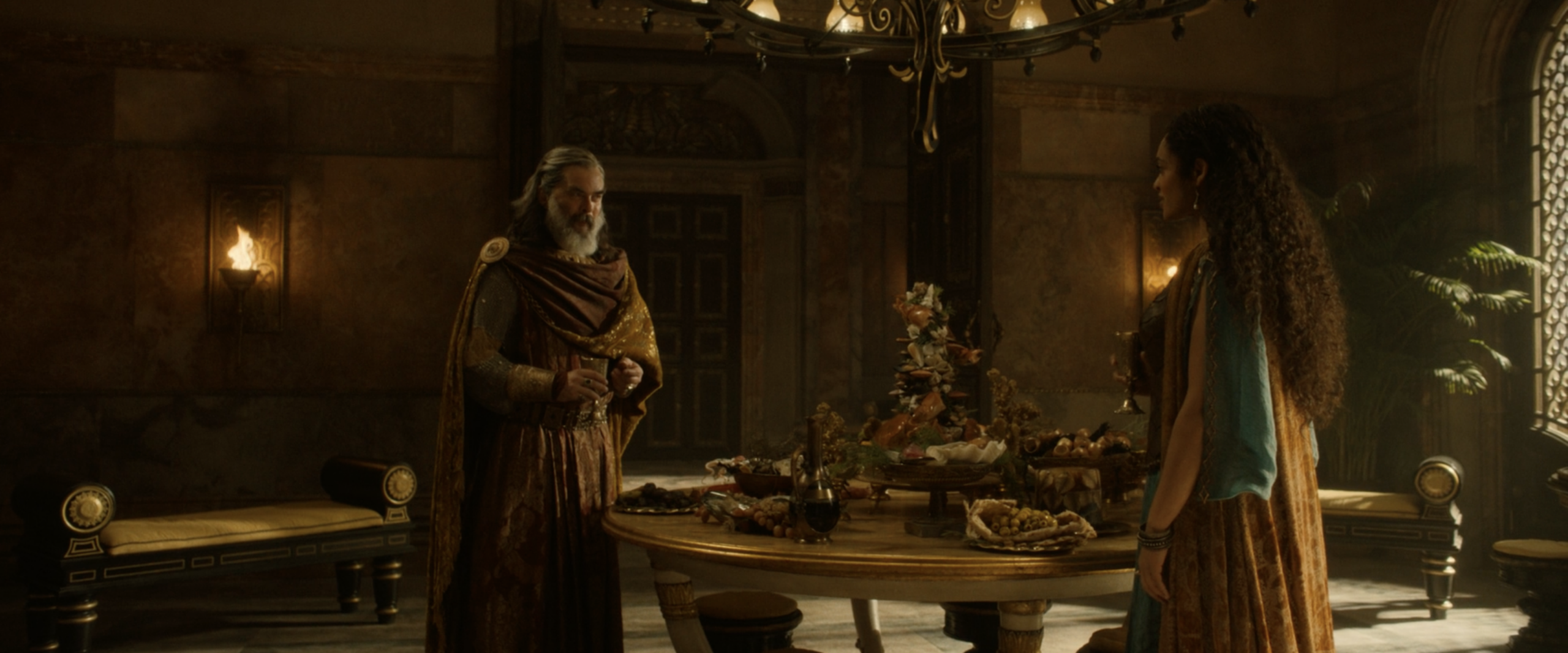
Míriel offers her armies, in response for freedom for the Faithful to live and believe as they will. A mere diplomatic alliance will not be enough, given the fractious state of Númenórean society at this point, so Ar-Pharazôn offers “a proposal”, and here book fans know exactly what he’s proposing: an (illegal) marriage of convenience. In the Akallabêth this marriage is done by force, but in Appendix A of Lord of the Rings, only the seizure of the royal sceptre is mentioned. Many fans have been hoping for a sensitive treatment in this adaptation, in a way that retains Míriel’s agency, and it seems this needle will be neatly threaded, but we are left hanging. Later, Elendil gets the news that Míriel has indeed chosen to marry Ar-Pharazôn, and, predictably, takes it badly.
Now we are one
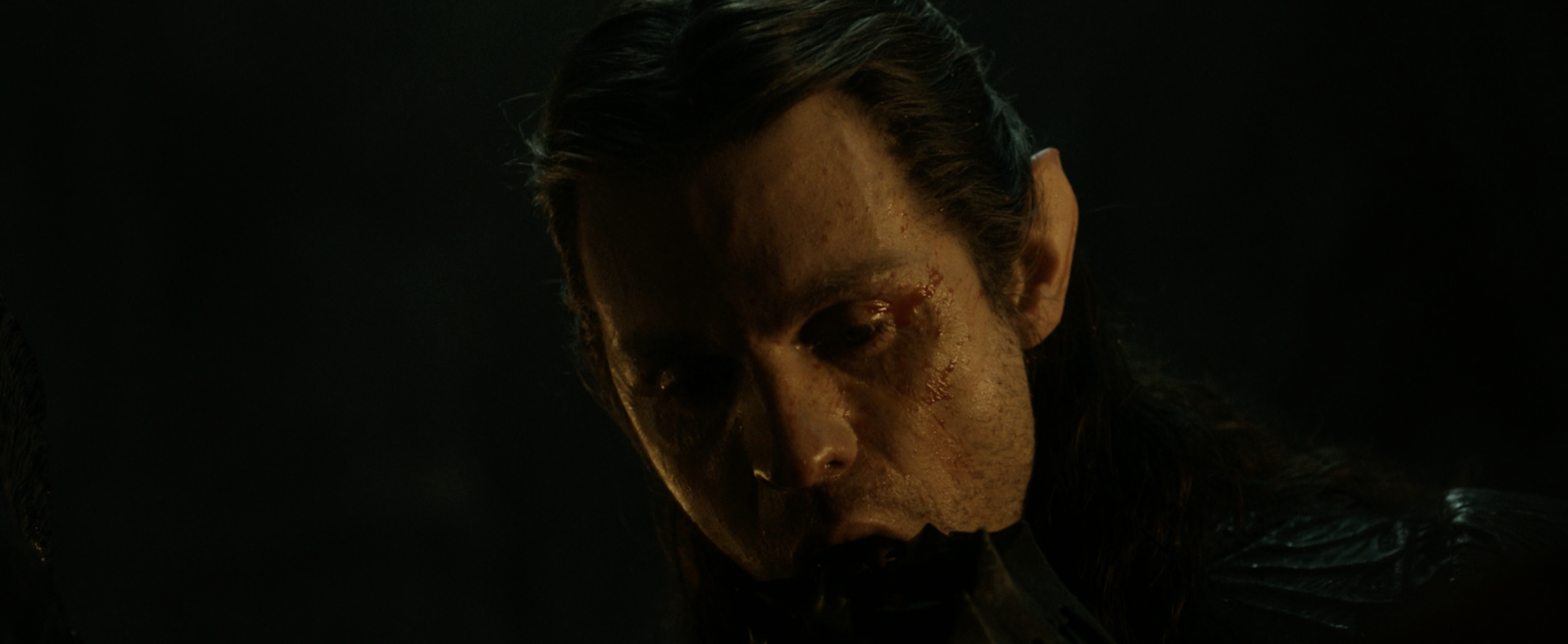
Now that Celeborn has, as an orc says to Sauron, “half the volcano on ‘im”, and might be worth more alive, the Dark Lord goes in for another tack. He explains how criminals had been executed in Mount Doom over a thousand years, and their evil, but also their screams, were trapped in the mountain; a perversion of the sanctity of the Dwarven mountains and the stone singers’ relationship with them. In response to further attempts at manipulation, Celeborn, despite his intense physical suffering, spits bloody saliva in Sauron’s face, but instead of the expected reaction this delights Sauron. He wipes his cheek and slowly licks the blood off his gauntlet, announcing disturbingly “Now we are one. Now we are joined. New we can begin.”
Deep in Khazad-dûm, Disa has led the miners and Lady Freyja to a narrow tunnel, and lo and behold, it’s the other side of the rock wall of Durin’s cell: under the promise the dwarven rings are nearby, the wall is broken, and the royal couple overpower Thrain’s collaborators. Unfortunately, Durin tells Disa for the first time where he hid the rings: in their house. Lady Frejya is not as unconscious as it seemed she was, signalling trouble ahead, as we leave the dwarves until next time.
Need something … hotter
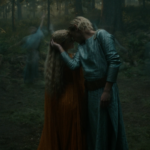
Celeborn has apparently been given a moment of reprieve from his torture, and in busts Galadriel, decapitating orc guards and so on, ready to get him out. Groggily, he reassures her that he didn’t tell Sauron what he knew. It turns out that the late elven smith Maitalle, his prison mate, told Celeborn everything she know about every moment she had spent with Galadriel. Perhaps due to the extreme duress, Celeborn showed he did know the secret Sauron wanted, and in a horrible twist, ‘Galadriel’ kisses him deeply, and as the camera pans past, it’s really his tormentor pulling off something like the fake-Amlach trick from the Silmarillion. In the First Age, one of the groups of the Edain (Men who’d come west and encountered the Eldar) were debating whether to ally with the elves or not. Amlach, one of the leaders, seemed to go off at the meeting and be completely anti-elvish, but later it turns out he was never there: it was instead a servant of Morgoth who’d shape-shifted to impersonate Amlach, and it’s often theorised by fans, if not stated outright, that it could have been Sauron.
Finally, the Chekhov’s hammer from season 1 is ready to go off: but there’s one more wrinkle. Celebrimbor’s ghost/memory taunts Sauron that Fëanor made his hammer to be unbreakable, not even dragon fire could damage it. How could Sauron get the gold and silver from Valinor out of the hammer to cast his long-desired master ring? The dramatic irony, immediate to the audience familiar with the description of the One Ring from Gandalf, takes a while to dawn on Celebrimbor: there’s a massive volcano right next door…

No Comments