
Nolan was right to bet the house with Tenet – A Review
This review contains moderate spoilers.
What happens when Christopher Nolan takes the laws of physics, folds them into a paper aeroplane and hurls the thing through a burning building? Tenet. An extraordinarily ballsy spy thriller which takes Nolan’s lifelong obsession with non-linear storytelling and pushes it beyond narrative structure, forcing time itself to become part of the action.
For all its reputation as an impenetrable work of temporal tax law, Tenet is not especially difficult to follow. The broader movement of the story remains clear while its details arrive so quickly that they often disappear from memory before the movie circles back to complete them. The question is rarely “What is happening?” and more often “Which of the seventeen important things that happened forty minutes ago does this connect to?” Nolan does not wait for one revelation to settle before introducing the next, but the velocity prevents that density from becoming oppressive. Tenet races ahead, trusting that anything truly important will eventually return from the opposite direction.
“Don’t try to understand it. Feel it” has been mocked as Nolan granting himself diplomatic immunity from his own screenplay, but it is also the correct way to watch the movie. The mechanics matter, yet the experience matters more, and Tenet’s greatest achievement is turning time from an abstract concept into something physical. Bullets leap out of walls. Buildings are destroyed and reconstructed in the same instant. A wrecked car rolls back onto its wheels before returning to the collision that overturned it. Effects become visible before their causes, forcing the eye to accept movements which remain just about recognisable in isolation but feel fundamentally wrong when assembled.
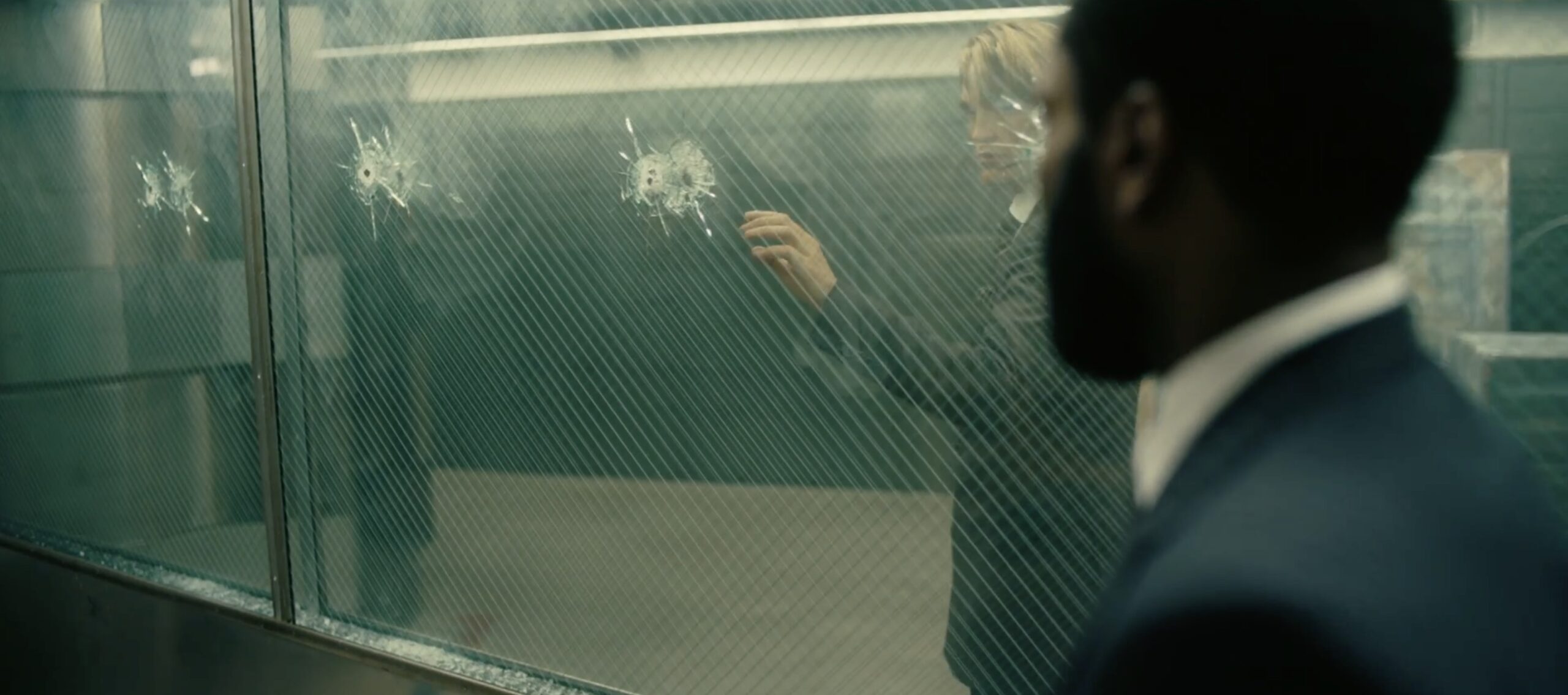
The first temporal fight is fascinating, although more impressive as a technical achievement than exhilarating as action. The choreography carries a slight stiffness, as if both men are wrestling the premise as much as one another. That stiffness disappears once the movie no longer has to demonstrate what inversion can do and begins speaking fluently through it. A relatively straightforward road heist in Tallinn mutates into a chase where forward and inverted movement occupy the same motorway. When the movie later returns to the sequence from the other direction, events we thought we understood are completed rather than merely replayed. Effects arrive before the actions that cause them. Nolan takes one of cinema’s most familiar forms and makes it uncertain again, preserving the ordinary pleasures of speed, impact and pursuit while forcing them to obey a new order of entropy.
Then there is the plane crash. Tenet calmly proposes driving a Boeing 747 into a Freeport and, several minutes later, does exactly that. The sequence completely lives up to its reputation. It is crazy that anybody conceived it, secured permission for it and somehow emerged with a film rather than an insurance investigation.
The conviction behind Tenet extended beyond anything visible on screen. Nolan pushed a $200 million spectacle into half-open cinemas during the pandemic, surrendering part of his compensation as it acquired the impossible expectation that it might ‘rescue’ the medium. When Warner Bros later announced its HBO Max strategy without consulting its filmmakers, he walked. Rather than retreat, Nolan took the same enormous, stubborn ambition to Universal and doubled down with Oppenheimer, a three-hour historical drama which made almost a billion dollars and won seven Oscars. It could not retroactively make Tenet the saviour of cinema, but it vindicated the filmmaking conviction Tenet embodies.
For all its physical immensity, Tenet’s most impressive feat of construction may be how tightly it folds back over itself. It is less Chekhov’s gun than Chekhov’s armoury: objects, gestures and apparently incidental lines are introduced long before their real function becomes visible. Entire scenes acquire new meanings when approached from the opposite direction. Even the names participate in the design. Sator the arms dealer, Arepo the art forger, Tenet the organisation, the Kyiv opera house and Rotas Security reproduce the five words of the Sator Square, embedding an ancient palindrome inside a movie forever approaching its own events from the other side. Its pay-offs often work by showing us the answer before we have encountered the question. An impossible movement becomes natural from another perspective; an unexplained detail becomes evidence; a casual line travels through the movie before reaching its meaning. By the time Tenet returns to an earlier moment, we may know that the return is coming. What we cannot always predict is how completely it will change what that moment means.

For a movie moving this quickly, Tenet is astonishingly beautiful. Hoyte van Hoytema finds grandeur in ships cutting across open water, convoys consuming whole stretches of road and human figures placed inside architecture vast enough to reduce them to moving marks. The images communicate geography and movement while remaining beautiful in their own right. There are countless shots which provoke an immediate “wow, what a shot”, even as the movie refuses to pause long enough to admire them. Ludwig Göransson’s phenomenal score begins driving Tenet from the first moments of the opera-house assault and scarcely releases its grip. Its brutal, mechanical pulse makes the movie feel as though it has been moving towards impact since the instant it began. The sound design makes inversion audible as well as visible, reversing and rearranging familiar noises until the ear recognises what happened without instinctively accepting how it happened.
The sound mixing is much less consistent. At home, some dialogue disappears beneath music, engines and explosions. That problem has become one of the defining complaints about Tenet, and the criticism is fair, but its vehemence led me to expect something far more destructive to the experience. A handful of obscured lines never made the story incomprehensible, nor did the sound collapse into the apocalyptic wall of noise I had been promised. Tenet on rare occasions makes you strain to hear it, but it never made me want to stop listening.
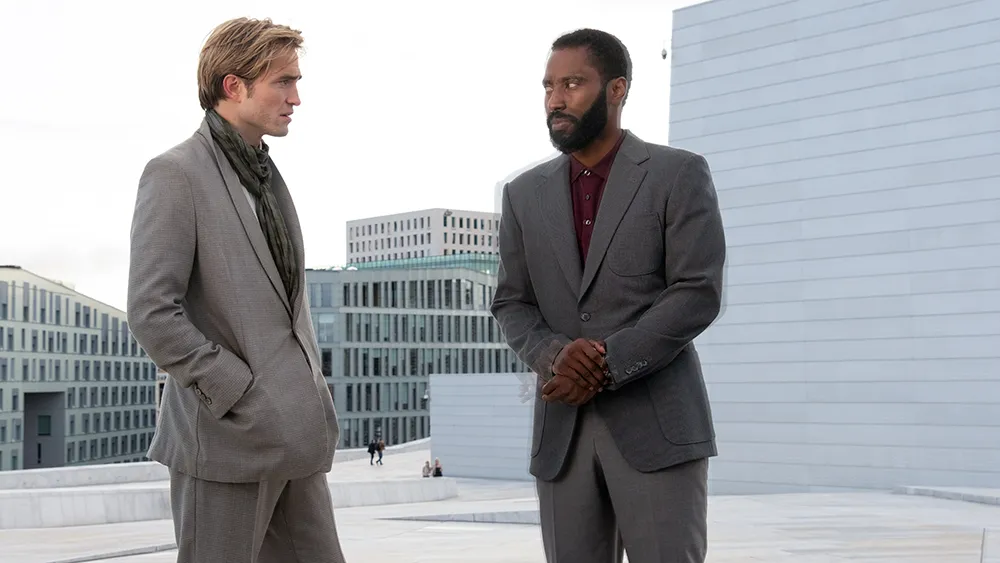
John David Washington has the strangest assignment in an already strange movie: anchoring all this without a name, much of a history or any real opportunity to exist outside the mission. He responds with physical authority, composure and a dry delivery well suited to someone defined by anonymity and momentum. There is no disguising that his range feels narrower beside a supporting cast that is considerably more expressive, and he is rarely the most compelling performer in a scene. Yet Washington’s restraint may be part of why Tenet remains so navigable. He never fights the machinery for attention, but he has enough understated charisma to prevent the deliberately blank Protagonist from becoming genuinely empty.
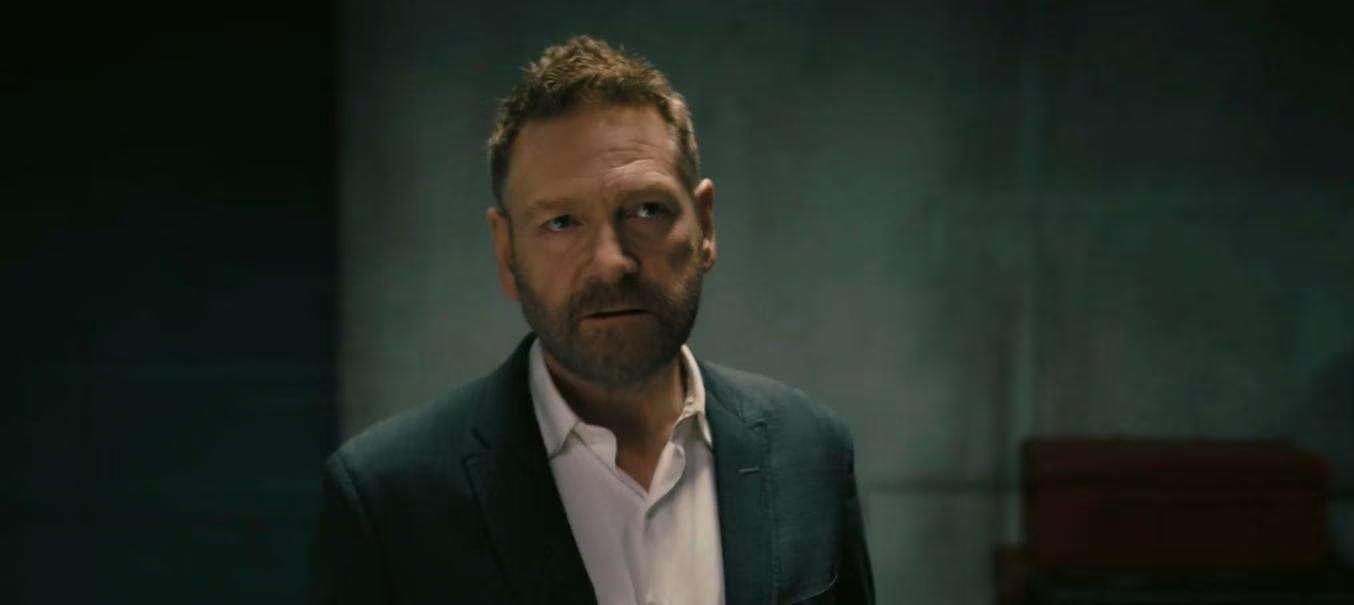
Around him, Kenneth Branagh embraces Sator’s monstrous theatricality, performing his cruelty and possessiveness at operatic volume without allowing either to become harmless. He is grotesque, excessive and enormously entertaining, exactly the sort of villain a movie this severe needs.
Elizabeth Debicki gives Kat’s desperation and fury the conviction her part of the story requires, ensuring that the personal stakes survive beneath the possible annihilation of existence. Aaron Taylor-Johnson and Himesh Patel arrive later, giving the movie another injection of personality, the former carrying the authority of somebody who has already survived a much stranger version of Tenet, the latter treating the destruction of a passenger jet as an unusually complicated booking.
Robert Pattinson is magnetic as Neil, drifting through the film with the amused nonchalance of somebody who already knows more than everyone else in the room. He wears his polish lightly, never seeming especially impressed by the danger or interested in making an impression himself. Beneath that composure is, of course, a hint of the endearing weirdo Pattinson seems able to find in even his most abhorrent characters.
For all its machinery, Tenet comes to rest on a grace note. Pattinson carries that same lightness into Neil’s final exchange with the Protagonist, where the affection beneath their easy rapport comes fully into view. Their goodbye is genuinely moving, and the scene gives the whole film a sense of completion without making a grand show of it.
The scene which follows resolves the Protagonist’s arc and gives Washington a line which is, to put it academically, bars. It is satisfying, but I believe Tenet would have been tighter without it. By then, the film has already reached its climax, the heart beneath the temporal grandiosity revealed in the space of a single conversation.


No Comments