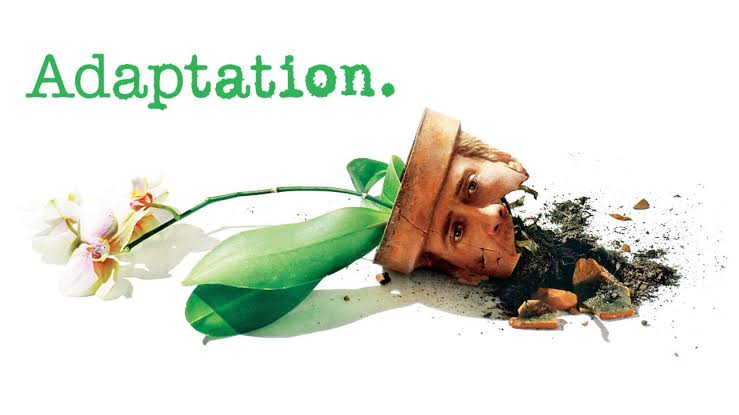
Adaptation. Sees the Sadness and Calls it Lovely – A Review
This review contains heavy spoilers.
Charlie Kaufman cannot find the beginning of Adaptation., which is awkward, because we are already watching it.
His voice races through sweat, thinning hair, imagined rejection and things he should have said differently while his body stands stranded on the set of Being John Malkovich. Everybody around him appears to have a purpose. Charlie wrote the film they are making, yet somehow looks as though he wandered in by mistake.
His next job is adapting Susan Orlean’s The Orchid Thief, a book about flowers, obsession and the people who surrender their lives to both. Charlie wants to preserve all of it. No invented romance. No guns. No car chase. Nothing false dragged in to make the flowers easier to sell. He wants to write something simple about their beauty.
He cannot write a word.
Soon the unwritten screenplay has swallowed everything. Charlie’s career, body, loneliness and masculinity collapse into the same private verdict. He does not merely want the script to be intelligent; he needs its intelligence to justify him. If he writes something ordinary, perhaps he is ordinary. Writer’s block becomes evidence that he is not only a bad writer, but an inadequate man.
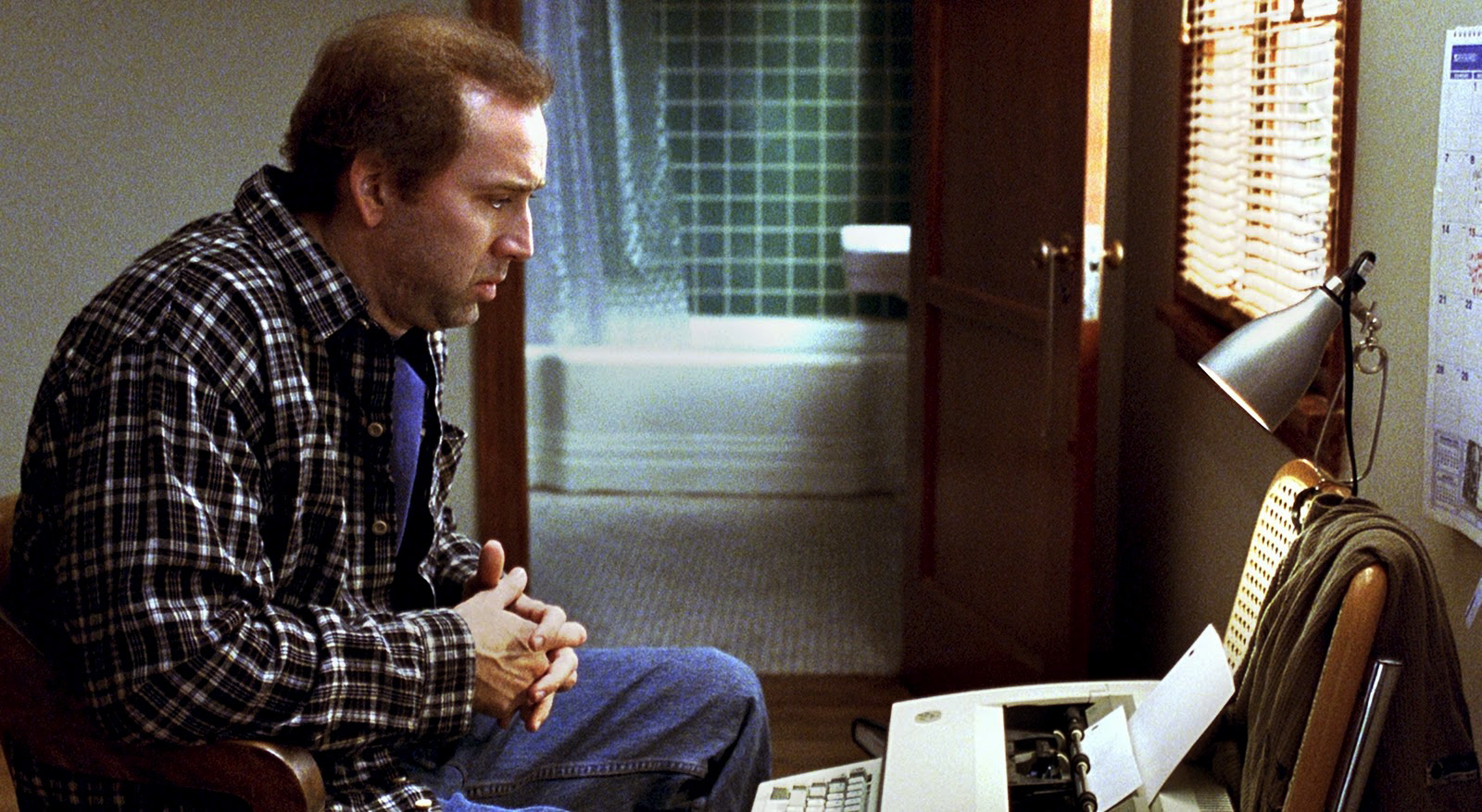
That hit me harder than I expected. Watching Charlie pace his room, dictate an opening, hate it and return to the beginning felt less like observing writer’s block than having one of my own worst habits performed back at me. I know the urge to make every piece of writing carry the full weight of what I might be capable of. I know how quickly ambition becomes paralysis once a page must prove that the person writing it deserves to continue.
Then Donald walks in wearing the same face but none of the insecurity.
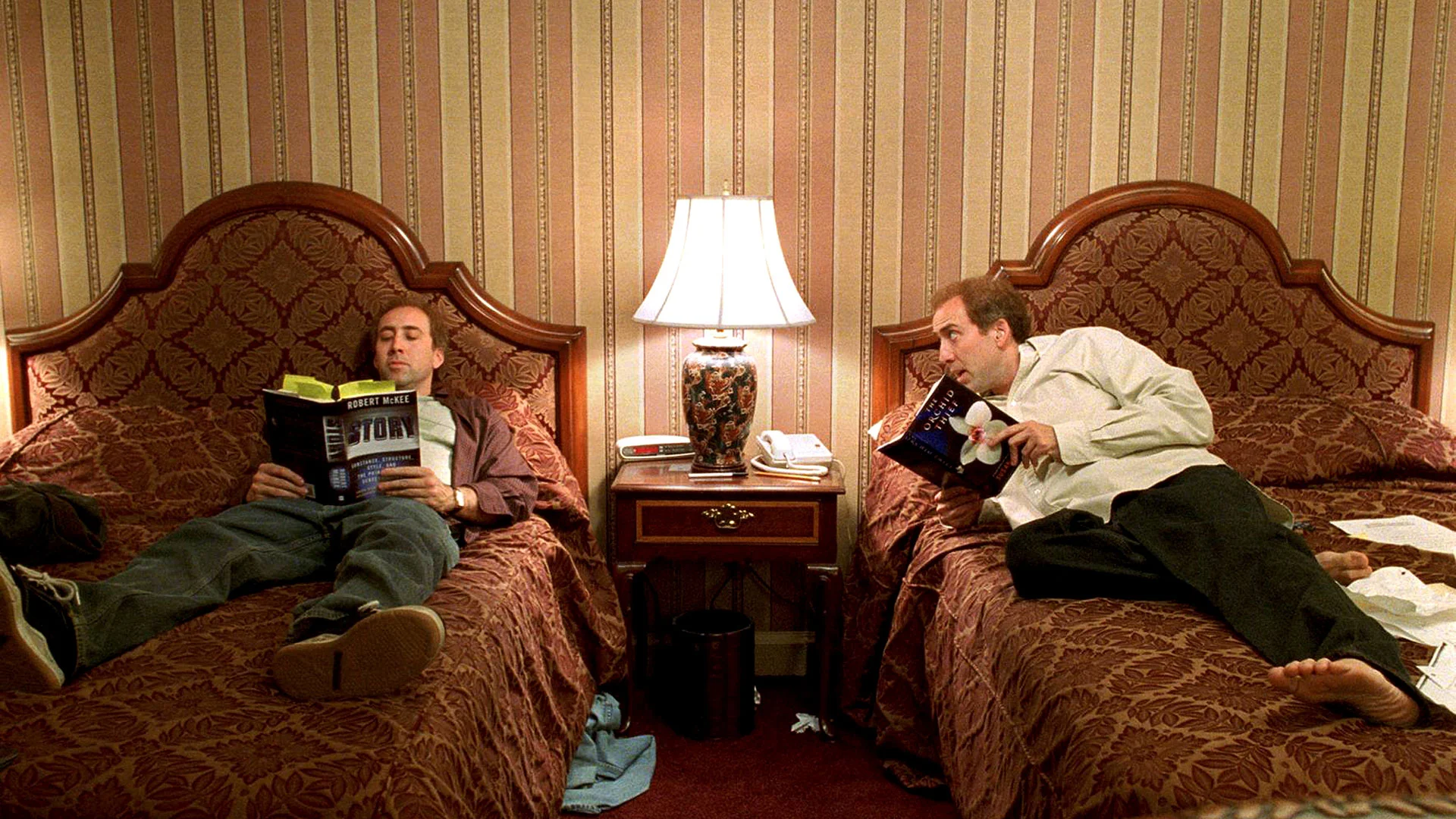
Cage plays Charlie’s fictional twin as open, affectionate and almost offensively untroubled. Donald decides to become a screenwriter, attends Robert McKee’s seminar and begins a serial-killer thriller assembled from every idea Charlie considers beneath him. Multiple personalities. Broken mirrors. A murderer forcing his victims to eat themselves. Donald sells it for a fortune.
He is the opposite of Charlie in all the ways that hurt. He writes freely, speaks to women without rehearsing his own rejection and asks for help without treating the need as proof of failure. He is not the writer I want to be, exactly. He is the version of myself I wish I could reach more consistently: lighter, less afraid of looking foolish and able to make something before deciding whether it deserves to exist.
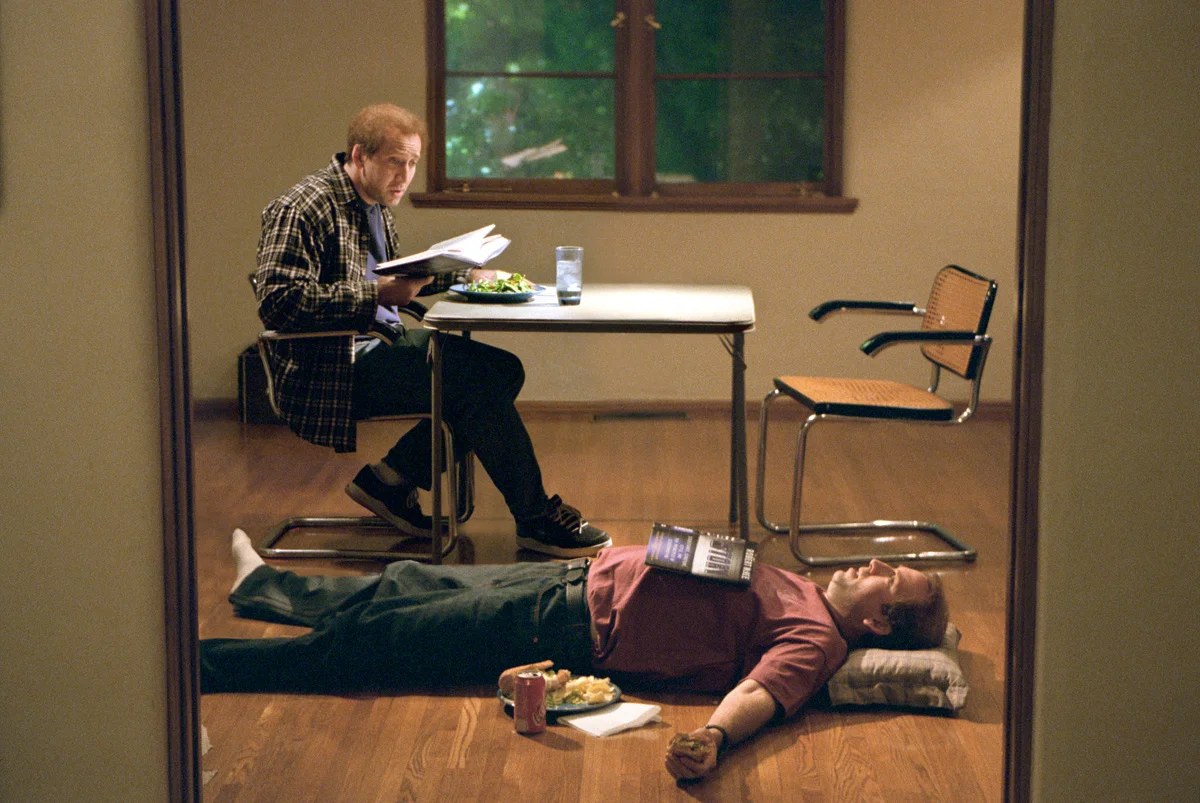
Cage finds the difference between the brothers without turning either into a collection of tricks. Charlie acts like he has apologised before he has spoken. Donald talks in the same rolling rhythm, but expects the room to welcome him. They interrupt each other, borrow clothes and offer advice nobody asked for until the technical achievement gives way to something warmer. They feel like brothers.
Donald could have stayed a punchline, a cheerful cliché machine sent to punish Charlie for caring too much. Instead, Kaufman lets him understand something Charlie does not. When the girl he loved laughed at him, Donald knew. He was hurt, but her cruelty could not make his feelings foolish. He had loved her, and that belonged to him. Charlie has spent his life doing the opposite. Every rejection is collected, catalogued and brought forward as evidence in the next case against himself.
The same hunger runs through Susan Orlean’s fascination with John Laroche. It is not really the orchids that draw her towards him. It is the ease with which he can care. Orchids, turtles, tropical fish, mirrors. He gives himself completely to one fascination, then wakes up finished with it and wanders towards another. Susan watches from the safety of description, longing to know what it feels like to want anything that much.
Charlie wants Susan’s book to reveal its story. Susan wants Laroche to reveal his secret. Laroche wants the ghost orchid. Desire keeps passing from one person to the next until it reaches a flower that could not care less about any of them. The title stretches across all of it: a book becoming a screenplay, people reshaping themselves around whoever they envy, Darwin waiting beneath the whole thing. Eventually the film must adapt as well.
Then Brian Cox arrives to shout at the screenplay.
Robert McKee is a pompous dick, played with the certainty of a man who has converted storytelling into immutable law. Charlie asks whether a film can simply observe life without forcing it into crisis, revelation and change. McKee reacts as though he has insulted every story ever told. Nothing happens in the real world? People are murdered. Nations starve. A man watching his mother die still finds time for a joke. He is unbearable, and exactly what Charlie needs.
The final act becomes everything Charlie promised to avoid. Sex, drugs and guns barrel into the film, followed by a chase through the swamp and an alligator with impeccable timing. Donald’s screenplay appears to infect Charlie’s while McKee grabs the structure with both hands and drags it towards an ending.
It is ridiculous, but it hurts. Donald dies in exactly the kind of third-act machinery Charlie would have mocked, yet the grief does not feel false. Convention has not poisoned the emotion. Avoiding convention would never have guaranteed honesty. McKee does not win as completely as he would probably claim. He condemns voice-over, and Charlie’s never leaves. The film absorbs his crisis, action and transformation, then ignores whichever commandments do not suit it. He is not a prophet. He is raw material, one more thing for Charlie to adapt. McKee gives Charlie an ending. Donald gives him a reason to reach it.
“You are what you love, not what loves you.”

No Comments