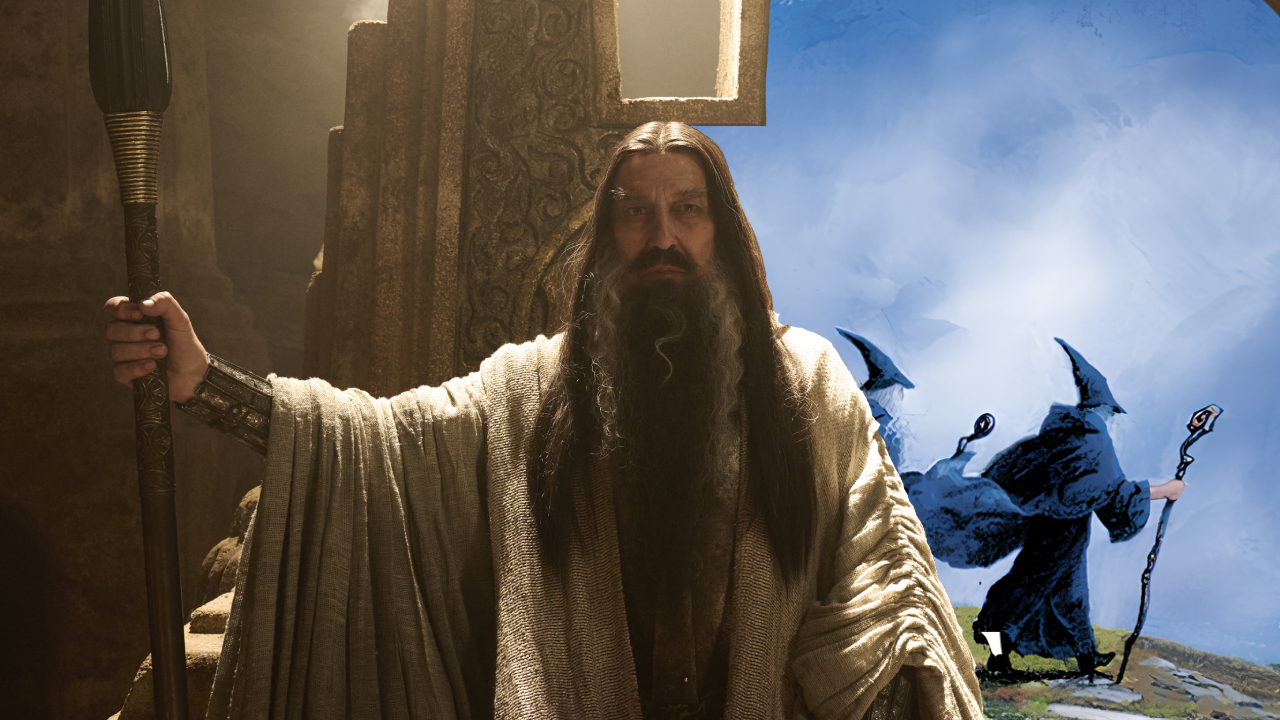
EXCLUSIVE: The Dark Wizard’s identity revealed for The Rings of Power Season 3
Ever since The Lord of the Rings: Rings of Power, set in Tolkien’s historical Second Age, was known to feature a wizard or wizards, fans immediately leapt to consider what was known about the so-called ‘Blue Wizards’. These are the only ones that are, in one version in a late posthumously-published text at least, present at this point in Middle-earth’s history. That the Stranger from Season 1 is confirmed to be an Istar and not Sauron was as step towards revealing the show’s vision of the Valar’s messengers (‘ἄγγελος’, as Tolkien admitted in Letter 156). Exactly which Istar was left to subsequently unfold as the Stranger figured out who he was, or more precisely who he would become over time.
However, in Season 2 we are introduced to another Istar, and, well, the can’t both be Gandalf. So the question was left open: who is the Dark Wizard, played by Hinds? If we accept Tom Bombadil’s assessment of him as correct, and the idea of one of the Istari ending up as the later Witch King is a big stretch, then the list is short: Saruman (ruled out explicitly by the showrunners in an interview), Radagast (unthinkable, really), one of the ‘other two wizards’ … or an original character not described by Tolkien. The last of these would be a very bold move, and it’s now safe to say this is not the case. This leaves us with the ‘other two’. While these are generally known as the ‘Blue Wizards‘, I am going to avoid this generic description from now, for reasons I hope will become clear.
The trouble with making an adaptation that includes a wizard that’s not Gandalf, Saruman or Radagast is that Tolkien didn’t write just one version (like Second Age Galadriel and Celeborn), but, worst of all, he wrote nothing about them in the text of The Lord of the Rings. That the first Jackson Hobbit film, An Unexpected Journey, had Gandalf say ‘the two Blue wizards’ in response to Bilbo’s question about who the other wizards were was in fact a cheeky overstep of the source material licensed to New Line/Warner Brothers. And, like other material collated and published in Unfinished Tales and History of Middle-earth (RIP Christopher Tolkien)—and in Tolkien’s Letters, the short snippets are inconsistent with each other. To make the briefest summary:
- Generic ‘rods of the five wizards’ side-reference in Lord of the Rings asserting the existence of two more wizards off-screen, and the timeline event that the wizards arrived in Middle-earth around year 1000 of the Third Age.
- The ‘Essay on the Istari’ (written in 1954, published in Unfinished Tales), giving us the title ‘Ithryn Luin‘ (Blue Wizards), that they went east, and never came back west—and that they probably failed.
- An undated note about choosing of the Istari (possibly after 1956, in my estimation, also in Unfinished Tales), giving us the personal names Alatar and Pallando, that Alatar volunteered to go, and took Pallando along as a friend.
- Letter 211, to Rhona Beare in 1958, about the other two wizards (emphasis added):
I have not named the colours, because I do not know them. I doubt if they had distinctive colours. Distinction was only required in the case of the three who remained in the relatively small area of the North-west. (On the names see Q[uestion].) I really do not know anything clearly about the other two – since they do not concern the history of the N.W. I think they went as emissaries to distant regions, East and South, far out of Númenórean range: missionaries to ‘enemy-occupied’ lands, as it were. What success they had I do not know; but I fear that they failed, as Saruman did, though doubtless in different ways; and I suspect they were founders or beginners of secret cults and ‘magic’ traditions that outlasted the fall of Sauron.
- A linguistic note from about 1959 giving the names Palacendo (possibly “*Far sighted one”) and Haimenar (possibly “*Far-farer”).
- A later text ‘The Five Wizards’ (from about 1972, just two paragraphs, published in Peoples of Middle-earth), giving a Second Age arrival date (a similar time to Glorfindel), the names Morinehtar (darkness-slayer) and Rómestámo (east-helper), and they had a great effect on reducing Sauron’s forces in the east in the Second Age.
I wanted to give all those points up front, because it shows that the decision by the showrunners of who the Dark Wizard turns out to be is not an obvious one. The ‘other two wizards’ have really been different characters over time, with three sets of names, a joint title subsequently discarded, and completely opposite outcomes from their stories. Fellowship of Fans has previously revealed that the show has gotten permission from the Tolkien Estate on two accounts regarding the Istari:
Excl: For Rhun Amazon got special permission and access to two texts outside of the Appendices- one being from the Unfinished Tales around the Istari and consequently access to use all 5 wizards if needed. The other text they got access to is where Tolkien mentioned some of the Istari being around in the Second Age and travelling East.
—@fellowshipfans 5:35 AM · Feb 5, 2024
The first text described is slightly ambiguous, but the Istari chapter from Unfinished Tales as a whole contains most of the above points, plus much more, and the second text must be the two paragraphs from 1972. This gives access to four of the six names above, and both main versions of their stories.
Who the Dark Wizard is
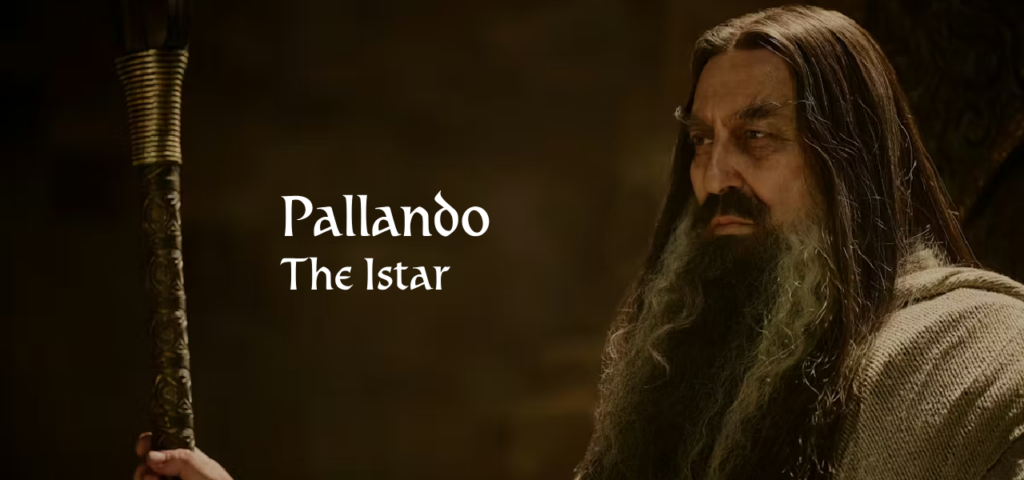
EXCLUSIVE: Ciarán Hinds plays ‘PALLANDO’ the Blue Wizard, now turned dark, in The Lord of the Rings: The Rings of Power Season 3.
He is one of the five members of the Order of Wizards—known as the Istari—a group that will be referenced in the show.
So, yes: the Dark Wizard can be now revealed as being Pallando. One might fruitfully wonder why this name rather than any other. If we take the general arc in Season 2 of the Dark Wizard as given, and this was it seems written in 2020, before Season 1 aired, then there are some obvious restrictions from the sake of maintaining some level of consistency. Making the Dark Wizard Morinehtar would make little sense, given his turn to establishing what seems very much like an dark magic cult, despite his claims of wanting to oppose Sauron. Similarly it’s hard to see him as ‘helping in the east’, so Rómestámo is unlikely, and his cultivating of the Rhûnic people is hardly setting them up to oppose Sauron. If anything, if they turn against the Dark Wizard and what seems to be his curse on them, then Sauron might find them willing converts, as it were. This seems very much to go against the ‘They must have had very great influence on the history of the Second Age and Third Age in weakening and disarraying the forces of East [illegible]’ story from 1972, if the people of Rhûn rebel against the Dark Wizard and join with the new, very helpful King of Men that Sauron paints himself as.
The other option not used is then Alatar. In the Unfinished Tales Istari material, Alatar is described as being picked by Oromë, but little else is known about him specifically, rather than their pair of them. At least the meme of servants of Aulë going bad would be subverted, but there’s a more prosaic problem one might want to avoid: name confusion with Sauron’s Annatar guise in Season 2. Even more accidentally amusing would be the fact this would be the second time a wizard’s name sounds very close to Sauron’s name (the Saruman/Sauron similarity has been noted by many, even leading to the Bakshi film adopting ‘Aruman’, temporarily). Tolkien himself, of course, had no issues whatsoever with similar-sounding names, but was also sensitive to fine points of etymology from his own languages. If there was a 50/50 split on which one to take, then Pallando makes the most sense from the out-of-show, production point of view. Another reason, more technical, is that the name Alatar is not given a translation of Tolkien, but it seems to have an element meaning ‘radiant’ (similar to Altáriel, that is, Galadriel). I would think having a Dark Wizard who name refers to light is thematically awkward.
However, just having the name Pallando doesn’t tell us everything about the show’s adapted story: it’s a hint that Rings of Power is going with the earlier version of the story, where at least one of the ‘other two’ wizards are not a resounding success. People have also theorised that perhaps the show will go a ‘one good’/’one bad’ mix of the stories, or even that Gandalf is filling the role of an eastern wizard (‘Gandalf the Blue’). Fans have long made headcanon synthesis about the Blue Wizards, often applying this name even to the versions of them when Tolkien has appeared to have dropped the title. Calling him ‘Pallando the Blue Wizard’, when Tolkien may not have mixed these two names, seems like falling in line with common practice. If the show has rights to all of the Istari chapter, then it would have the legal right to adapt (and remix) this material. It’s not in the source texts we know the show has permission for, but Letter 211 mentioning that the two eastern Istari were far out of Númenórean range feels like a general point that could sharply delineate the two plotlines, of Númenor and of Rhûn.
The question this of course raises is whether we are going to get Pallando’s colleague, per the text. Comment with your theories!


Michelle Johnston
January 29, 2026 at 12:50 amWe are beginning to see two themes emerge here.
1) The use of characters excluded from the main narrative or films. First, we have Tom; now we have Pallando.
2) I have always believed the star sign was important, and Pallando looks up at it at the end of Season 2. He is waiting for Alatar and mistakenly thought that Gandalf was his companion. I believe they will honour the text and Sauron will remain Gandalf’s chief adversary in the 3rd age alone.
However, Alatar will find himself caught between Gandalf and Pallando, in a not dissimilar way but more developed than Radagast, with Gandalf and Saruman. Who should he trust? There is a good deal of room for a side plot with a different kind of approach, as Sauron/Elves/Numenor/Dwarves begins to resolve into a single geopolitical thread with lots of traditional action. In the books, Mr Tolkien elaborates on the unique and difficult challenges the Istari face, having no waking recollection, more of a dream state of their lives in Valinor. They are clothed in the deceits of men. Whilst it was a slow burn to get to Gandalf, oddly, that echoed the sense of not having a waking understanding. I would like to see that played out in their various arcs and, of course, draw in the Entwives’ gardens and the early Hobbits as the plot devices over which the Istari argue. The idea that it is difficult to tell humble goodness from evil has already been played out in Season 1 with the three witches, but that was for a false trail. That, too, can be exploited more fully with the arrival of Alatar. Essentially, Pallando and Gandalf can fight over Alatar’s soul, the Ent wives and the Hobbits.
Pingback: 'The Rings of Power's Wizard Issue Fixes a LOTR Problem – random blog
February 8, 2026 at 1:24 am